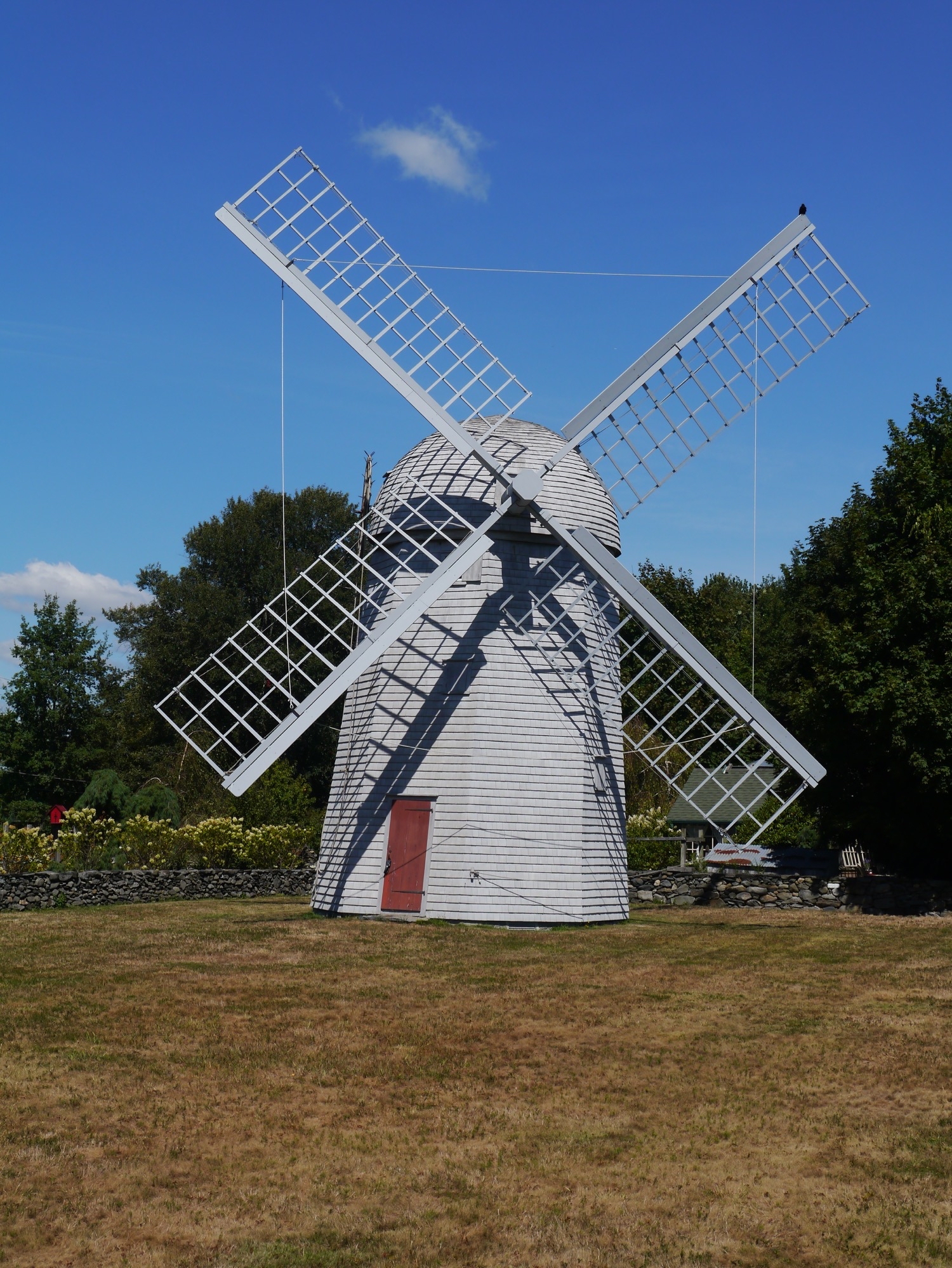
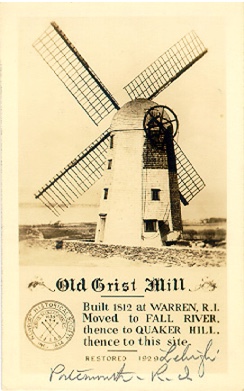
I came across a clipping that was from the Newport Mercury in June of 1933. This was a lette to the editor by Benjamin Boyd describing the history of the Sherman mill that is at Prescott Farm today. He has a nice style of writing, so I transcribed it and am including it in this blog.
Sherman Mill – Benjamin Boyd’s Letter to the Editor Newport Mercury, June 2, 1933.
“This mill was built in Warren, RI in 1812 and was connected with a distillery. Later it was moved to Fall River and later to Portsmouth, RI. The dates of these removals I do not know. When I was a boy, of a dozen years old or so, it belonged to Robert Sherman and stood just north of the present Newport County Fair Grounds. Mr. Sherman at that time looked to me like a middle aged man but whether he bought the mill and moved it from Fall River or whether his father or someone else did I do not know. The mill was the largest and most powerful one ever built in this county, so far as my knowledge goes. It described a circle, when running 70 feet in diameter and drove two sets of millstones. It was an unruly bird and was liable to become unmanageable in squally weather. Only the most experienced wind grist mill miller, and men having full knowledge of what the vagaries of changing gale and storms would do to mill arms, with a leverage of 35 feet swinging 15 to 25 Revolutions per minute were capable of handling this mill.
I recall that Mr. Sherman was sick all one winter and hired a man by the name of Almy to run his mill. Mr. Almy had run a water mill which was located in the Glen, now part of the Taylor estate, but his knowledge of wind power was more theoretical than practical. There came a day, when Mr Almy discovered that unlike watermills, wind mills had a way of acting very independent. Mr. Almy found out about these things on one of those typical March days, when the wind will be blowing a light breeze and the sun shining in an innocent kind of way, and in 15 minutes a snow squall will be raging and the wind bowing hard enough to take the hair of one’s head. The old mill was probably turning around but not grinding much, and Mr. Almy was probably sitting on a bag of flour, very likely musing on the wherefore of the which or why this should be thus when it should be otherwise. About this time the snow squall struck and things became otherwise with a vengeance. The old mill immediately went into high gear full speed ahead which certainly meant disaster, and caused Mr Almy to apply the brake to the main shafts so he could stop and shorten sail. An experienced miller would have seen this squall coming in advance and shortened all, but brakes propose and winds dispose, so the old mill did not stop. Then Mr. Almy bethought himself to try the expedient of filling the eye of the mill stone with grain to choke it up and help the brake to stop the mill. He succeeded in stopping all the internal machinery of the mill, but he could not stop the mill arms. They twisted off the 26 inch oak shaft and went over the mill taking most of the top with them.
Later Mr. Almy was asked what he thought of wind grist mills and he said that there were only two things that had ever beat him – red-headed women and windmills. The next day as a boy of 12 or 13 I saw the wreck of this mill and it was certainly some wreck. The mill was fitted again but was soon sold to the late Benjamin Hall Senior and his brother William who ran the Adams House in Boston. These men had the mill moved to a farm they owned on Lehigh Hill on the West Road about one half mile east of the Portsmouth Coal Mines.
____?Sherman, a well known mover of buildings at that date, moved the mill for them down Quaker Hill on the East road through Freeborn Street and up Lehigh Hill.
I remember seeing the mill being moved down Quaker Hill. Mr. Sherman had a large rock chained to the mill, and this rock dragged on the ground behind the mill as a brake. Old people will remember Mr. Sherman as the one who moved a church that stood on Bedforrd Street in Fall River to Rock Street, and then turned it round by putting a large cannon ball under the center of the building placing the planks for the rollers in a circle.
Mr. Sherman bought the mill and farm of the Halls, and ran it for a number of years. After he passed away this property went back into the hands of William Hall, and after to a family by the name of Sowle. Some four or five years ago, the Newport Historical Society bought the mill and about one acre of land. The Mill was repaired and I understand it is open to visitors. There is a signboard at the entrance telling when and where it was built.”
There are a number of Mr. Shermans in the piece and I am not sure who is who.
He ends with an interesting phrase:
The Mills of the Gods grind slowly
But they grind exceeding small
While the wind mills of humanity vanish
And Death takes the Millers as toll.