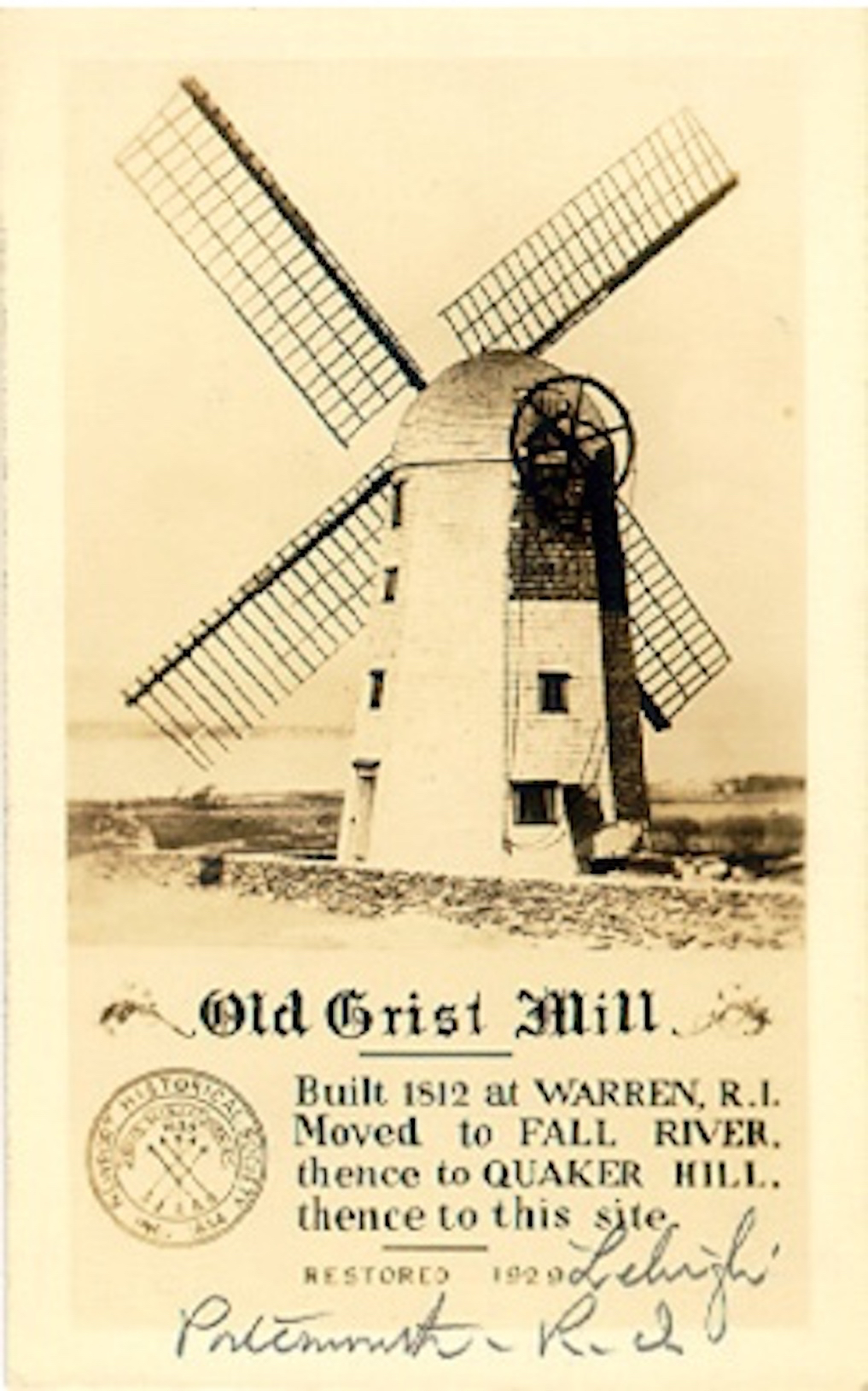
I had a query about the mill on Old Mill Lane and I went to my maps to determine when and where the mill would have been. I remember researching Benjamin Boyd and reading an article about him. He mentioned that when he was growing up there were 10 mills in Portsmouth. At the time of the interview there were only three left – Boyd’s Mill (now at Paradise Park in Middletown), Sherman Mill (now at Prescott Farm) and the Almy or Thurston Mill which was destroyed in a fire. Aquidneck Island had more windmills than most other areas. And so I am going to do a deep dive into the history of Portsmouth mills.
Common Types of Mills:
1. Gristmills grind corn, wheat or other grains into flour using heavy millstones. As a farming community, these mills were essential. Boyd’s Mill and Sherman Mill are examples of gristmills. Sometimes the miller was paid with a portion of what they ground.
2. Sawmills: These were up and running early on to provide lumber for home construction. Some of these early mills were water powered, but later some were turbine powered.
3. Textile Mills: We may not associate mills that make fabric from wool and other fibers with Portsmouth, but there were fabric mills in the Glen.
4. Carding Mills: These mills were common in Portsmouth’s Glen as well. Early on the wood fibers were “combed” by hand tools called cards. Using water power machinery to do that made the process easier.
5. Fulling Mills: Again, this type of mill existed in the Glen. Water was used to shrink wool fabric and tighten the weave.


Sep 29, 2026 @ 16:51:28
Great topic! There was a carding mill on Lawton Brook near Oak Glen (check out old maps). There were other mills along Lawton Brook/Wading River as well. Edward Lawton had a water run mill where the Lower Pond is now in Melville Park along that brook (recently named Matapurcetti Brook). There is also some old account/history that stated that there were no water powered mills on Aquidneck Island because there were no streams. Of course that is not/was not true, but that false history has survived the ages because a few years ago when I visited Biscuit City and the old ruin of a water mill there near URI, the guide repeated it to us. I am especially fond of Boyds Mill as it was on my old street I grew up on (Mill Lane) and was privleged to go inside it before it was moved and restored. As often as wind mills were moved around, Boyds mill was the only wind mill on the island that never moved during its entire useful life from 1810 thru c. 1950.