August 22. Lafayette is Major General for the Day. Lafayette and General Sullivan argue over Sullivan’s letter to D’Estaing. Lafayette refuses to agree to the letter because he finds it insulting to the French.
August 23. At counsel of War Lafayette backed an immediate retreat even though he was unhappy with the American position about the French. Lafayette is bitter about the claims the French deserted the Americans.
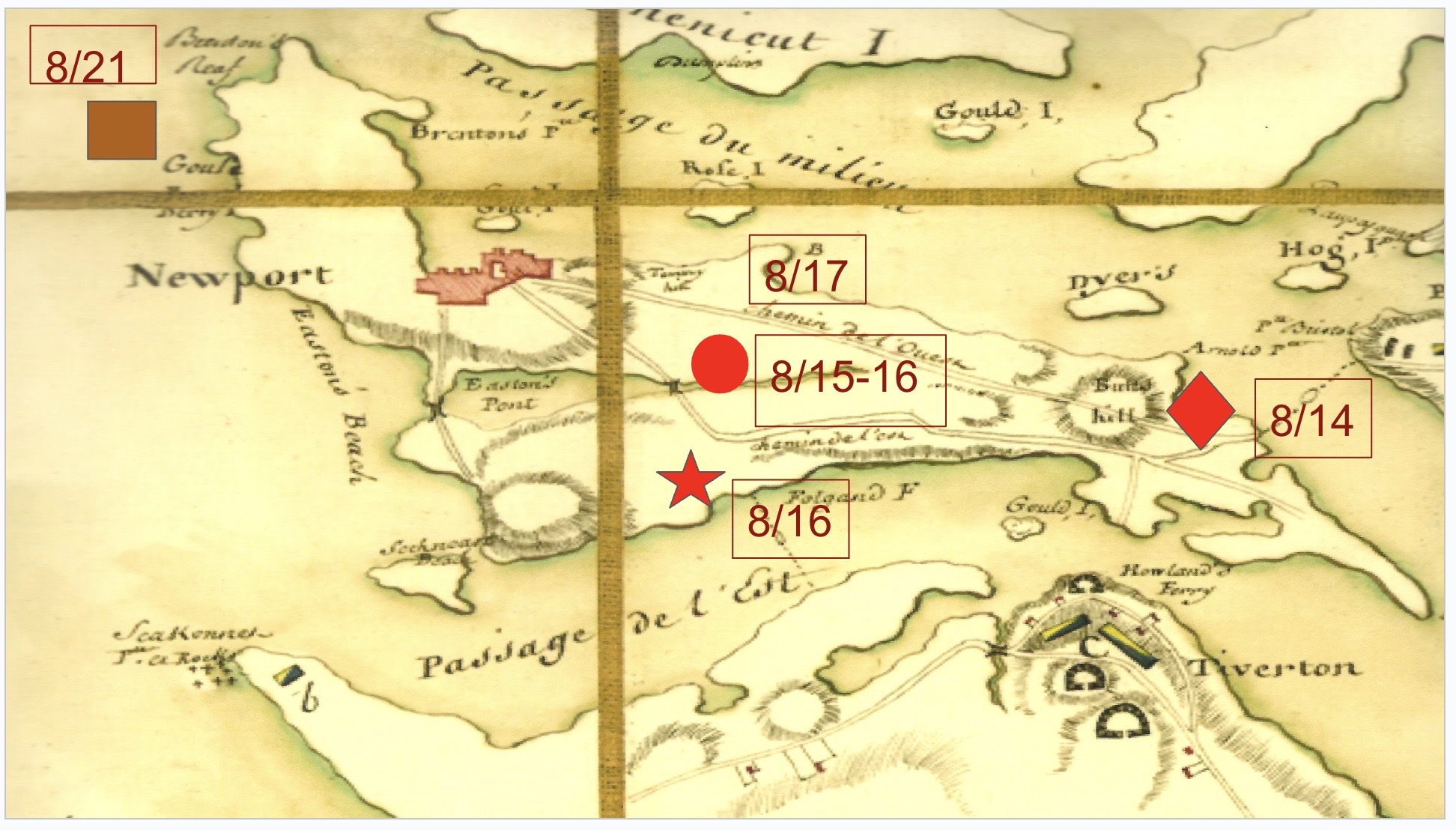
At Butts Hill (RED DIAMOND).
August 27. American forces decide to move to Butts Hill.
August 27. Lafayette leaves that evening to ride to Boston to talk to d’Estaing. Lafayette crosses Howland Ferry (RED TRIANGLE) to Tiverton.
August 28. Lafayette rode all night. 7 hours and 70 miles. Lafayette arrives in Boston about the same time the French Fleet Arrived. Boston is marked with a BLUE STAR.
August 29. Lafayette, John Hancock and General Heath meet with d’Estaing at Hancock’s home in Boston (BLUE STAR). The French will not return to Rhode Island.
August 30. Lafayette returns at 11 PM to Portsmouth by way of Howland Ferry (RED TRIANGLE>. He has missed the battle but has taken a role in the retreat.
August 31. Lafayette escorts the last pickets are off the Island via Howland Ferry (RED TRIANGLE) after 2 AM.
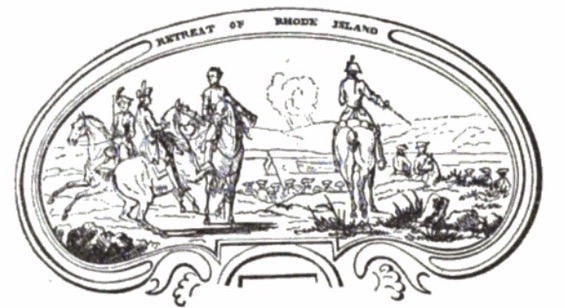
“Retreat of Rhode Island” One of the medallions on the guard of the sword presented to Lafayette by the Congress. In Recollections of the Private Life of Lafayette by Cloquet.
Resources:
Kitchin, Thomas. “A map of the colony of Rhode Island.” Map. London: Printed for R. Baldwin at the Rose, Pater Noster Row, 1778. Digital Commonwealth, https://ark.digitalcommonwealth.org/ark:/50959/6t053p17c (accessed January 16, 2024).
August 14th. The storm ends. Americans begin new earthworks at Butts Hill marked with RED DIAMOND. Early morning the soldiers “examine their arms and renewed their cartridges.” (Cutler’s diary) Supplies had been damaged in the storm.
August 15th. At 6 AM the whole army proceeds to march toward Newport in three columns. Americans halt advance at between 4 and 5 PM within site of the British lines. American lines run from West Main Road to Green End in Middletown marked with a RED CIRCLE.
August 16th. Americans are building a four cannon battery north of Green End marked by RED CIRCLE. The British fire their cannons at them. A diary notes that Lafayette is camped at the Bowler Farm on Wapping Road marked by the RED STAR.
August 17th. Lafayette is Major General for the day. Siege operations (marked by RED CIRCLE) are in full force. Lafayette oversees the siege works from the top of a house. The British attacked the house and Culter’s diary entry remarks: “Stood by the Marquis when a cannon ball just passed us. Was pleased with his firmness..”
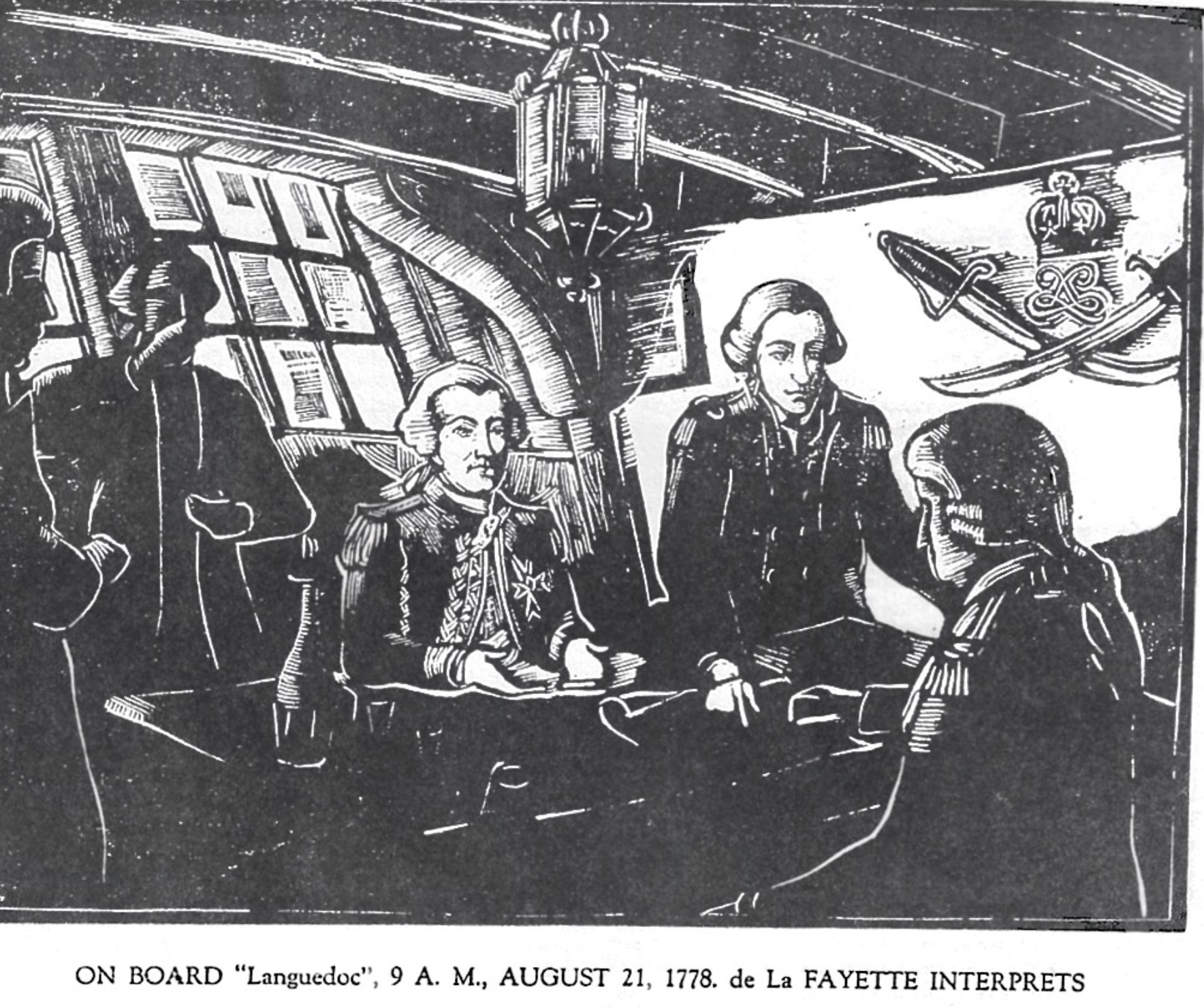
August 21. Lafayette, General Green and Col. Langdon go aboard the Languedoc marked with a BROWN CIRCLE. The French only agree to take American forces off of Aquidneck Island. Americans would not agree to that and the French fleet would sail away.
Woodcut by Howard Benson in Eric O.D. Taylor’s “The Campaign on Rhode Island.” Used with permission of Benson family.
Source: Life, Journals and Correspondence of Rev. Manassa Cutler. https://archive.org/details/lifejournalscorr01cutl
Red Triangle: Americans learn the British have left northern Aquidneck Island known as Rhode Island. Sullivan orders his troops to cross over to Portsmouth at Howland Ferry.
Brown Square: At 4 PM Lafayette goes onboard D’Estaing’s ship Languedoc out to sea by Newport. The ship is out to sea by Newport. The French decide to do battle with the British fleet that has appeared outside Newport. They are also unhappy that the Americans have moved onto Aquidneck Island before them.
August 10 – 13th, 1778
Red Diamond: Butts Hill area
August 10th, Lafayette and the Americans are camped around Butts Hill fortifications in Portsmouth.
August 11th, the Americans are still by Butts Hill with Lafayette as Major General of the Day. American troops parade at 4 PM. Lafayette’s troops paraded on the left and Greene’s troops on the right. A storm like a hurricane hits the island.
August 12th and 13th, the Storm is at its most fierce. Soldiers have no tents or shelter. Lafayette and Col. Wade inspect the water-logged American camp around Butts Hill.
British and French ships are returning damaged by the storm.
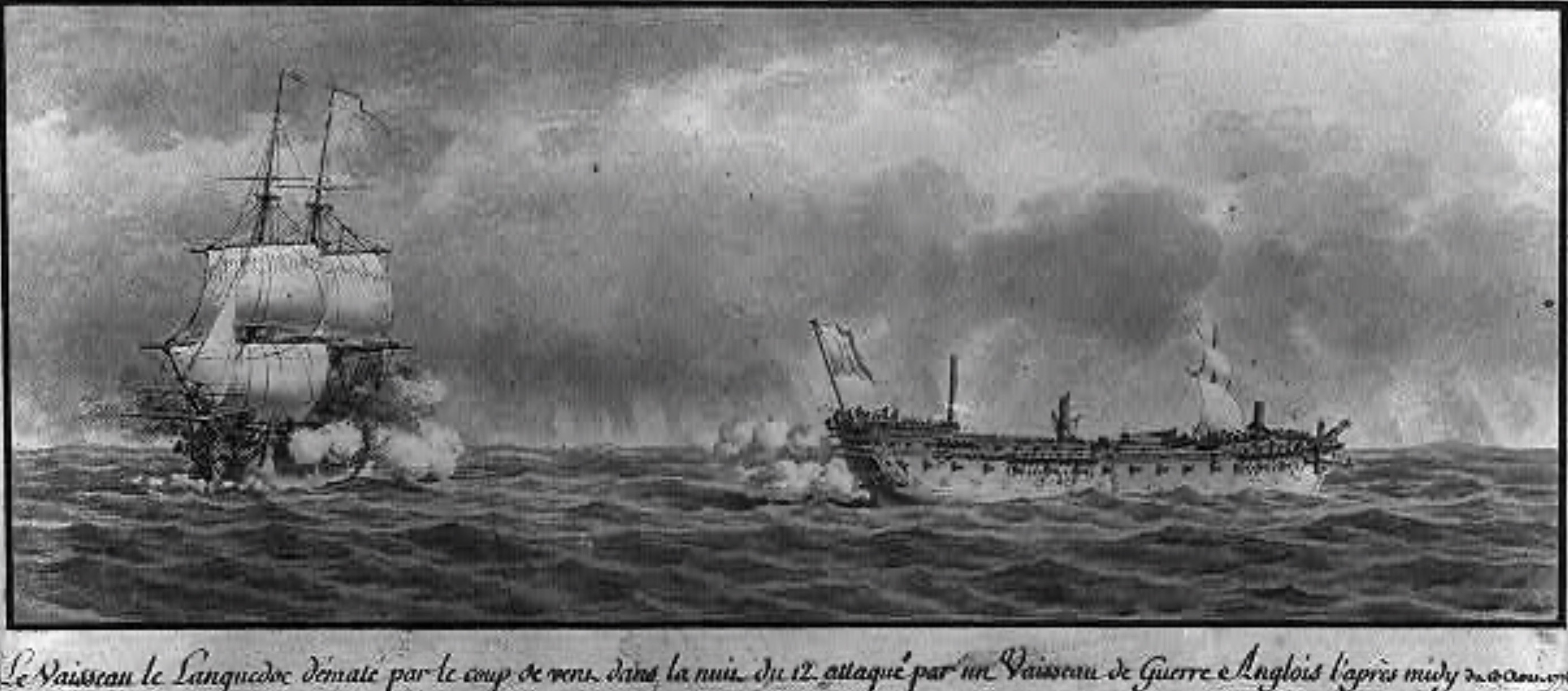
Languedoc returning without masts from Storm and Battle with British fleet.
Ozanne, Pierre, Artist. Le vaisseau le Languedoc dématé par le coup de vent dans le nuit du 12′ attaqué par un vaisseau de guerre Anglois l’après midy du 13 Aoust. [194] Photograph. Retrieved from the Library of Congress, <www.loc.gov/item/2004670063/>.
As a researcher for the Battle of Rhode Island Association, I was asked to investigate Lafayette’s role in the Rhode Island Campaign. I looked at the usual “Lafayette stayed here” locations and I wrote about them, but the more I researched the more I realized the very special role Lafayette played in the Rhode Island Campaign. My current project is to trace Lafayette’s movements throughout Rhode Island. It is both a timeline and an attempt to follow him on a map made by his cartographer at the time. What I am sharing now are my approximations. I have used his letters, Orderly Reports, diaries, and trusted secondary sources. Accounts do not always agree, so I have tried to make sure I had confirmations before I listed places and times. This is a work in progress and I would welcome corrections that give me more factual information.
On the Road: The Gathering of the Troops
The Marquis de Lafayette was hopeful about the Rhode Island Campaign as he marched toward Rhode Island. He wrote to General John Sullivan from Saybrook on 28 July, 1778: “I hope a pretty decent set of laurels may be collected upon that island, and we will terminate the whole by joining English country dances to French cotillions in company with the fine and reputed ladies of the charming place.” (1) (Idzerda)
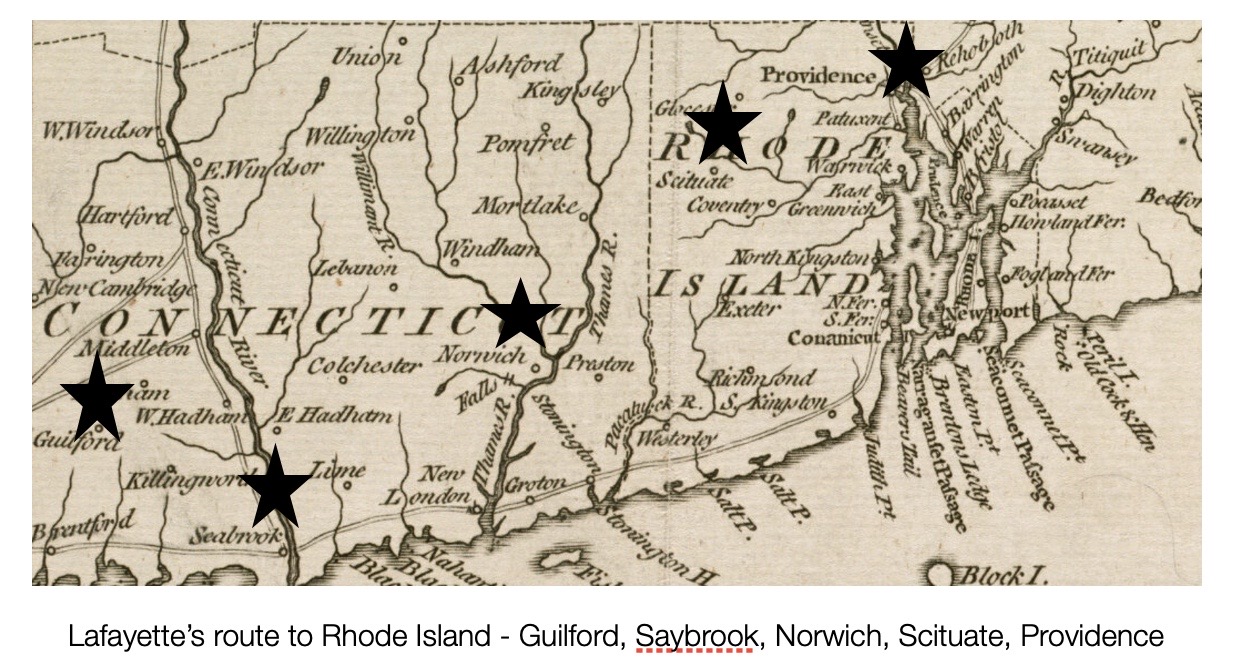
The Rhode Island Campaign was the first joint effort of the American and French forces during the American Revolution. In July of 1778 the French fleet under d’Estaing sailed to America. One idea was for the French to help American forces to free New York from British control, but the fleet had problems sailing in that direction. As d’Estaing steered his fleet toward Rhode Island, General Washington wrote to General Sullivan ordering him to raise 5,000 New England troops. He was to gather provisions and flatboats in preparation to work with the French fleet in releasing the British hold on Aquidneck Island (Rhode Island). Washington put twenty year old Lafayette in charge of General James Varnum’s four regiments as well as Glover’s and Jackson’s regiments. The troops had already started on the road to Rhode Island, and Lafayette had to catch up with them. By July 28th, 1778, Washington divided the forces into two divisions – one under General Nathanael Greene and the other under the leadership of Lafayette. The divisions would include both militia and the more experienced Continental troops. Lafayette caught up with his troops in Lyme, Connecticut. He took a route through Guilford, Saybrook, Norwich and Plainfield, Connecticut before he moved into Rhode Island.
Lafayette had a major role in the Rhode Island Campaign. To his dismay, he would miss being in the action at the Battle of Rhode Island, but he was active in every other phase of the Campaign. This timeline of his movements actually serves to illustrate the various stages of the Campaign. Lafayette was intimately involved in most segments of the action from August 1, 1778 to the end of September.
George Washington gave him joint command of the American troops.
He often served as “Major General of the Day” during the Siege of Newport. That meant he had the responsibility of reviewing the troops, checking supplies, attending the hospital, and carrying out discipline. He would assess the lines and entrenchments to place fortifications. He was the eyes and ears of the commander.
He was an American representative in talks with d’Estaing. He was sent to Boston in a last ditch effort to bring the French Fleet back to Newport.
On his return from Boston he led the last of the American forces off of Aquidneck Island.
He commanded the American troops guarding the East side of Narragansett Bay.
August 1,1778. Lafayette’s first stop is Angell’s Tavern (the GREEN SQUARE) in South Scituate, Rhode Island. The 2 divisions which had headed for Rhode Island met there. This was about 12 miles from Providence, so it was an opportunity for the troops to rest.
August 2-5 1778. Lafayette goes to Providence (located at the Green Circle) ahead of his troops. He stays with Governor Bowen. He accepts Washington’s orders that he shares command with General Greene.
August 4,1778. Lafayette was aboard the French flagship Le Languedoc (Brown Square) to meet with French commander d’Estaing. The French fleet was waiting off of Point Judith and d’Estaing provided Lafayette with the ship Provence to bring him back to Providence. Lafayette writes to d”Estaing on August 5th summarizing their discussions and he also relays the hesitance of Sullivan and Greene to a plan where Lafayette would head a joint effort with French soldiers.
August 6th through the 8th, 1778. Lafayette and his men march toward Tiverton through Rehoboth, Swansea and Fall River to the Howland Ferry., marked by the BLUE STAR. Lafayette is at Sullivan’s Headquarters at Tiverton by August 8th.
Idzerda, Stanley. Lafayette in the Age of the American Revolution, Selected Letters and Papers, 3 Volumes , 1776-1790. Cornell University : Ithaca,N.J. 1979.
A friend let me know that the old sheep shed at Glen Farm is gone. Only the foundation remains. When my Elmhurst students interviewed the Camara sisters many years ago, Geri Leis talked about this shed fondly. This is her clubhouse in the 1940s. In honor of the memories of the Sheep Shed, I am posting clips from interviews the Camara Sisters where they talk about what it was like to play on Glen Farm.
When Lafayette wrote Silas Talbot about a plan to capture the British vessel Pigot, he alluded to Talbots’s “reputation which you have already acquired by your zeal and skill in the artificial way (as a mechanic in the military).” Talbot was known as an “artificer” – “a soldier-mechanic attached to the artillery and engineer service, whose duty it is to construct and repair military materials.” 1. What was there in Talbot’s military history that had him known as a someone who could devise, construct and repair for a military campaign? Talbot had a record of invention, construction and even “daring do” to get the job done. All his past experiences made him useful to the American cause.
Silas Talbot was intimately involved in the Rhode Island Campaign. As someone with experience as a mariner and builder, Talbot helped to construct the flatboats that would take American forces to Portsmouth on August 9th of 1778. As a soldier, Talbot fought in the rear guard to protect the Patriots as they retreated to Tiverton on August 29th and 30th, 1778. Talbot alternated between roles as sailor and soldier throughout the American RevolutionSilas Talbot’s life was full of adventures. There were “rags to riches” stories and then again there were stories of monetary downfall. He was wounded in naval battles and sustained injuries on the Revolutionary War battlefields but he kept getting back into the action. This article will focus on some of those adventures of a representative figure in Revolutionary Rhode Island Talbot came from a humble background. He was born to a farming family in Dighton, Massachusetts in 1751. His father died when he was twelve and Silas was indentured to a local stonemason. He learned his skills as a bricklayer, but Dighton was a seaport and Silas signed on as a sailor on sloops transporting cargo from Narragansett Bay to as far as the Carolinas. By 1770 Silas settled in Providence where some of his older siblings had established themselves. Silas’ bricklaying skills were put to work in construction. Talbot wanted property and he put aside enough money to buy a lot of land on Weybosset Street. In 1772 Talbot married well. He continued to purchase land and he also began to purchase slaves. Owning a black servant was a status symbol for Talbot. He moved from being a laborer to owning a construction business.
In the aftermath of the burning of the Gaspee and the Boston Tea Party, Rhode Island merchants were alarmed. Independent militias were forming and Talbot joined and was commissioned as a Lieutenant. He joined others of his company in learning military skills in a Providence warehouse, but he didn’t have any real military experience. On June 28, 1775 Talbot answered the Rhode Island Assembly’s call to send units to Boston. He marched with his men to join the Second Rhode Island Regiment and by July 1, he was commissioned a captain. Talbot and the other 1200 men in the Rhode Island brigade took part in the Siege of Boston watching over the Red Coats but not in direct battle. Talbot’s skills as a bricklayer came in handy as they built barracks on Prospect Hill.
By April of 1776 the Siege was over and Talbot and the Rhode Island men were proud to welcome General Washington as he passed through town. As Washington arrived in New London, Rhode Islander Esek Hopkins presented Washington with a problem. Hopkins was Commander in Chief of the Continental Navy. Hopkins had sought safety in New London harbor after damage to his ships. Hopkins needed a crew to sail the ships home to Providence. Washington offered to loan Hopkins men from the Rhode Island Regiment. “All those acquainted with Sea Service that have a mind to join the Admiral as Volunteer have Liberty.” Silas Talbot took that opportunity to sail home to Providence. This was the first example of how Talbot’s military service frequently switched between the army and the navy. In August of 1776 he joined the Rhode Island troops in New York. In September he took part in an attempt to place a “fireship” (literally a ship set on fire with combustibles ) next to a British ship to catch it on fire. Talbot stayed on the “fireship” as long as he could to get it closer to the British vessel. Unfortunately the fireship did little damage, but Talbot was gravely burned.
While Talbot healed he served as a recruitment officer to enroll more Rhode Island troops to the cause. Talbot’s adventures continue in the next article.
Definition from Century Dictionary
Biographical information from William Fowler Jr’s Silas Talbot: Captain of Old Ironsides
We tend to think of the Rhode Island Campaign ending as the Americans retreated to Tiverton. I have been researching the movements of Lafayette in Rhode Island and I am more aware of the actions of the Continental troops on the East and West Bays directly after the retreat. Lafayette wrote letters that provide us with clues to what was happening in the East Bay. The Americans were successful in moving their troops and equipment off Aquidneck Island, but the decision of the French to leave for Boston to repair their ships left bitter feelings. Lafayette had an idea for a small victory to boost morale. On September 8th, 1778 he wrote to Silas Talbot . I am quoting the letter, but phrasing some of it in more modern language.
Sir,
The reputation which you have already acquired by your zeal and skill in the artificial way (as a mechanic in the military), leads me to communicate to you a plan where I think some success could be obtained. I wish to have heavy and strong scows upon each of them a twenty-four pounder would be fixed and then by a calm night, attack an English frigate who lies upon the North end of the island. The directions we could take should prevent her giving us any broadside before receiving many shots directed in such a way as to annoy them extremely.
In the same time she would be busy in her defense I wish two or four fire boats full of fascines, tar, old muskets, and bombs could be directed to the other side so as to enflame her.
If you believe, sir, such a scheme might succeed, I would be obliged to you to come immediately from Providence with such artificial provisions as would enable us to try the experiment without loss of time. You could take down two or three or more large scows or ferry boats who would extremely well do the business for fixing cannon on them. That affair must be kept very secret. With the greatest and more sincere esteem I have the honor to be dear sir your most obedient servant.
Silas Talbot did follow through with Lafayette’s idea. In coming blogs I will give more background on the adventures of Talbot and his daring exploits.
Letter taken from Lafayette in the Age of the American Revolution. Edited by Stanley J. Idzerda.
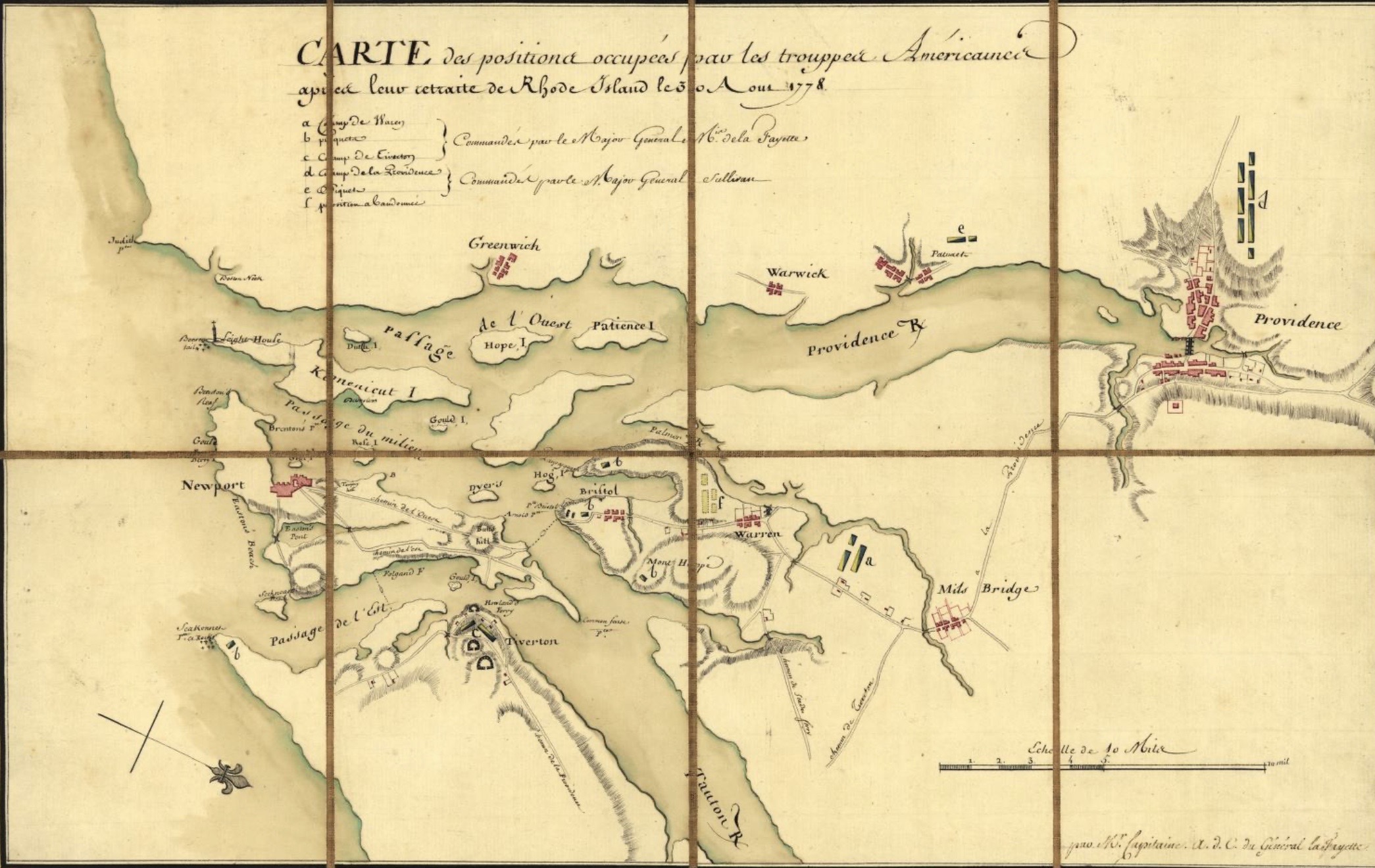
I have been searching for a way to illustrate the Marquis de Lafayette’s movements in Rhode Island and I came across a map that will be very helpful. It is a map of the positions of American troops in August of 1778. Rhode Island shorelines are prominent and the American camps are laid out so I can mark Lafayette’s positions throughout the Campaign.
I have seen (and used) this map before, but as I read Lafayette’s letters just before the Rhode Island Campaign, I came to appreciate this map and the French mapmaker, even more. The mapmaker was Michel Capitaine du Chesnoy. Chesnoy arrived in Charlestown, South Carolina with the teenage Lafayette. He was struck by an illness and it was only in the Spring of 1778 that he was well enough to help Lafayette. In his recovery he made maps of battles that he did not witness personally. He did a survey of the British positions at Ticonderoga, (Plan of Carillon or Ticonderoga). The map of Ticonderoga is unique, as mapmaker Chesnoy created the battlefield map through a combination of scouting accounts and secondary maps without visiting the area.
Chart of the positions occupied by American troops in Rhode Island August 1778 – Chesnoy
When Chesnoy came to America he was thirty-one years old and had been a lieutenant in the French army. He was made a Captain in the engineer corps of the Continental Army. Lafayette was unhappy with that because he considered Du Chesnoy his personal aide. The Marquis wrote to Henry Laurens in a letter dated July 23 from White Plains, New York.
“Mr. Capitaine one of my family has got the commission of a captain of engineers. ..Mr. Capitaine was in the Marshal of Broglios family, they made me a present of him and I attached him to serve me not only in America and in war but also to stay in the family in peaceable times. Such an officer I can’t spare, and I will employ him to make plans of our positions and battled for Gal. Washington, for me and for the king…The only way of getting him out of the engineer is to have for him a commission of Major in the line, he is now in my family but I want to have him entirely my supern-aide-de camp.” Note: A supernumerary aide had no regular duties and is held in reserve by the commander.
In January of 1779, Chesnoy followed Lafayette back to France. Chesnoy’s maps were used to persuade the French to continue to support the American forces. He presented a collection of his maps to the King of France. When he joined Lafayette in returning to America in 1780 he received a promotion to Captain in the French Army. He continued to serve as Lafayette’s mapmaker and aide-de-camp. His maps record the victories of the Virginia Campaign.
Chesnoy returned to France with Lafayette in 1781 but he kept his commission in the American army until it disbanded in 1783. He died in France in 1804, but his maps are still a valuable resource as we study the Rhode Island Campaign.
Resources:
Map: Capitaine Du Chesnoy, Michel, and Marie Joseph Paul Yves Roch Gilbert Du Motier Lafayette. Carte des positions occupeés par les trouppes Américaines apres leur retraite de Rhode Island le 30 Aout. [1778] Map. https://www.loc.gov/item/00555648/.
Did Paul Revere fight in the Battle of Rhode Island? No, but he participated in the Siege of Newport commanding his artillery company. A letter he wrote to his wife in August of 1778 gives us a glimpse of the experience of the American soldiers during the Siege.
We know the story of Revere’s “Midnight Ride,” but he was involved in more of the war effort than that. George Washington came to Boston in the Spring of 1776 days after the British had evacuated. Tradition has it that Washington asked Paul Revere (a craftsman) to repair the damage the British had done to the cannons on Castle Island. Revere was able to make the repairs and worked on a new type of gun-carriage as well. When Washington left Boston he took the majority of the Massachusetts troops with him. Boston was left to defend itself and on April 10th Revere was commissioned a major in the militia raised to defend Boston. Revere was sent to the Bridgewater area to learn from a French foundry man the method of casting of brass and iron to make cannons as well as the forges to make 18 pound shot. Revere would again meet this French foundry man, Louis de Maresquelle (a.k.a Lewis Ansart), when the Frenchman was an aide de camp to General Sullivan during the Rhode Island Campaign.
Newport Artillery Company fires a Paul Revere Cannon
Paul Revere took part in two efforts to remove the British from Aquidneck Island. The presence of the British in Rhode Island was a threat to Massachusetts. In the fall of 1777 Revere’s troops marched to Rhode Island and then back again. Boston printer John Boyle commented: “Nov 1 the 9000 Men lately raised to go upon a Secret Expedition returned home without effecting any Thing.”
Encouraged by the new French alliance, a second expedition was mounted in the summer of 1778. Col. Revere commanded the Boston artillery train and John Hancock was major general of the 3000 member Massachusetts militia. Revere’s heavy artillery headed for Rhode Island. At first Revere was encouraged about their chances of dislodging the British. While on Aquidneck Island Paul Revere wrote to his wife Rachel. (Annotations are added to make the references clearer to our modern readers.)
“My dear Girl, …Pray take care of yourself & my little ones. I hoped ere this too have been in Newport, my next hope will be dated there. We have had the most severe N. East Storms I ever knew, but thank Heaven, after 48 hours it is over.”
The storm was devastating to all sides. The French and the English warships were severely damaged. American troops had little shelter from the storm.
“I am in high health and spirits, & (so is) our Army. The Enemy dare not show their heads. We have had about 50 who have deserted to us; Hessians and others. They say more will desert & only wait for opportunity. I am told by the inhabitants that before we came on, they burned 6 of their Frigates; they have destroyed many houses between them & us. I hope we shall make them pay for all.”
When the French fleet entered Narragansett Bay on August 5, HMS Orpheus a 32 gun frigate was run aground at Almy’s Point and set on fire a few miles north of Newport on the west side of Aquidneck Island. The Juno, Lark and Cerberus were also scuttled and burned so that the French and Americans would not capture them. The were positioned so that the wrecks would block shipping lanes.
British maps recording the Siege of Newport show where houses were leveled in order to give British cannons a better line of fire.
“The French Fleet are not returned but I just heard they were off Point Judith with 3 frigates, prizes, this, I am told, comes from Head Quarters. I do not assert it for fact, but hope it is true”
When he wrote this letter, Revere was not aware of the damage to the French fleet.
“You have heard this Island is the Garden of America indeed it used to appeal so, but those British Savages have so abused and destroyed the Trees (the greater part of which was Fruit Trees) that it does not look like the same Island; some of the inhabitants who left it hardly know where to find their homes.”
After almost two years of occupation, Aquidneck Islanders lost almost all their trees and anything made of wood – docks, farm tools, wagons.
“Col. Crafts is obliged to act under Col. Crane which is a severe Mortification to him. I have but little to do with him having a separate command.”
Col. Crafts had turned down a military appointment because it was not high enough for someone of his stature. In the Rhode Island Campaign he was under the command of someone he had criticized as not being worthy of his position.
“It is very irksome to be separated from her whom I so tenderly love, and from my little lambs, but were I at home I should want to be here. It seems as if half Boston was here. I hope the affair will soon be settled. I think it will not be long first.”
The phrase, “It seems as if half Boston was here” is often quoted. The Boston militia was there.
“I trust that Allwise Being who has protected me will still protect me, and send me safely to the Arms of her whom it is my greatest happiness to call my own. Paul is well; send Duty and love to all. …Col. Matescall, (Lewis Ansart) who is one of General Sullivans Adi Camps, tell me this minute that the French have took a Transport with British Grenadiers, but could not tell particulars. Your own, Paul Revere”
Paul is Revere’s 18 year old son. He had been his father’s lieutenant and served with him.
When Paul Revere wrote this letter he did not know of the damage to the French fleet. When it was clear that the fleet would not return, the Massachusetts troops under John Hancock began to leave Aquidneck Island. Hancock complained of the length and tiresomeness of the campaign. He had heard that his child was sick and dying and he thought that if the the fleet had gone to Boston, he could facilitate the re-fitting of the ships. Hancock did his best to smooth over the testy relationship between D’Estaing who commanded the French fleet and the Americans.
Back in Boston Revere was losing men to service on three types of ships: privateers, Continental and Massachusetts. Some of his men had lost their blankets on the retreat from Rhode Island and lacked clothing, pay and ways to feed their families. Revere entered the action in Rhode Island with high spirits, but found discouragement in the aftermath.
Resources
Forbes, Esther. Paul Revere and the World He Lived In. Boston: Houghton, Mifflin, 1942. This source provided the background to Revere’s story and the letter from the Siege.
Boyle, John. Journal of Occurrences in Boston, 1759-1778 in N.E. Historical General Register. Quoted in Forbe’s book on Revere.
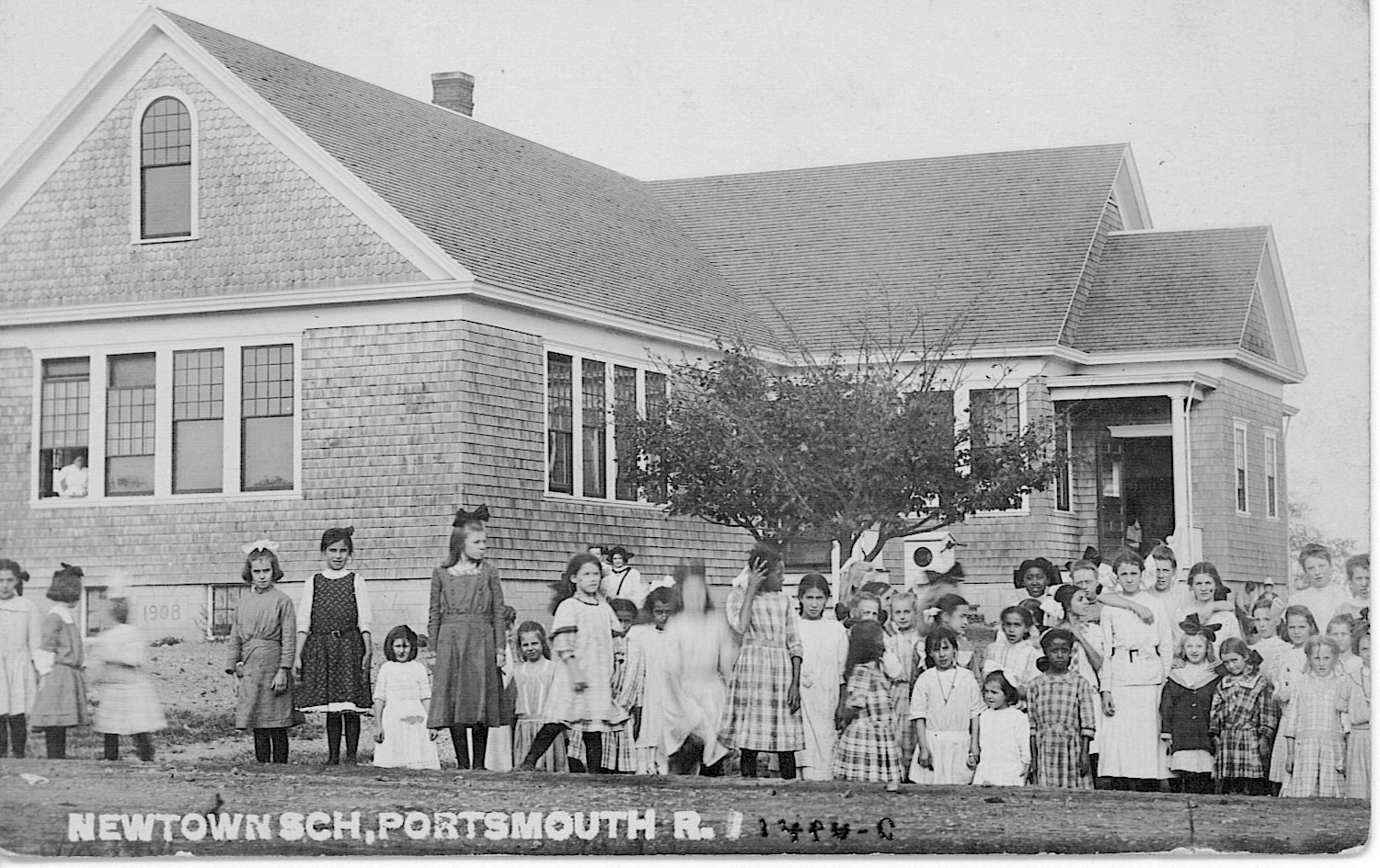
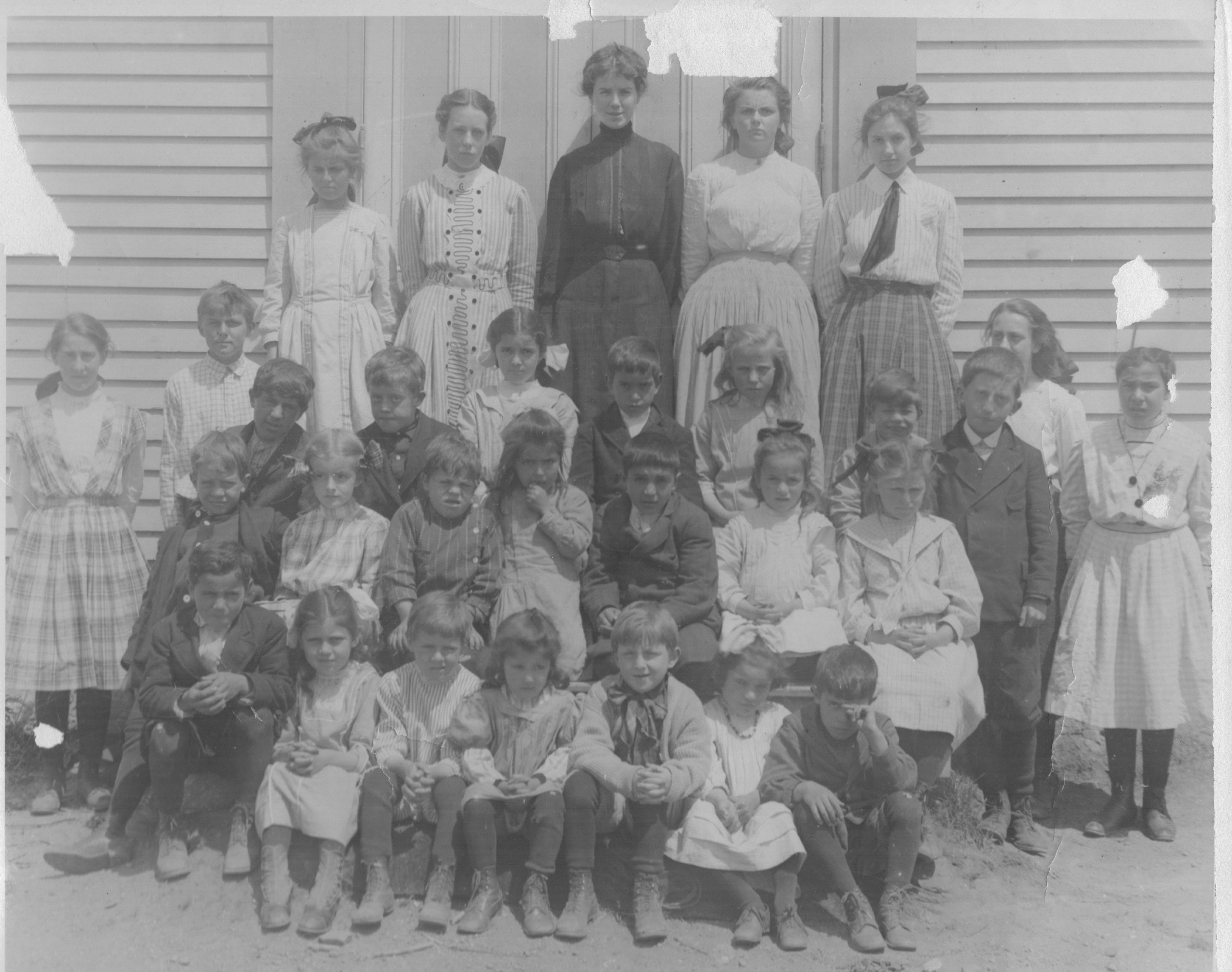
What was it like to go to a one or two room school? In 2005 Elmhurst 3rd graders interviewed Portsmouth residents who had that experience. Here is a sample of some of the questions and answers from those interviews.
Interview of Mr. Douglas Wilkey Quaker Hill School and other schools in the district
What did you wear? They wore knickers that went right under the knee and socks that pulled up and folded at the end.
How many students were in your class? There were from 32 to 36 students in the class.
How many classrooms were in your school? There were three classrooms at Newtown School. There were two rooms at Quaker Hill School. Anthony School had ten rooms. Anne Hutchinson and Coggeshall had four classrooms.
How were kids punished? We were whacked with rulers.
Mrs. Joy Schuur went to Coggeshall School
What were your teachers like? The teachers were single and when they got married they weren’t teachers.
What subjects did you have? We had more music than you do. They didn’t have library or gym. They had math, spelling and language.
What kind of holidays did you have? We had no spring break. There was a long Christmas and Easter break.
Miss Fay and Mrs. Powers went to Bristol Ferry School
What games did play at recess? We played hopscotch, jump rope and jacks. They had a morning recess which was fifteen minutes and afternoon recess after lunch which was an hour long.
How many grades were in your school? They had grade one to grade eight.
What did you wear to school? Girls wore dresses and cotton stockings. Boys wore pants or knickers.
What was the discipline like? If you got in trouble you would get sent out of the room, sent to the principal’s office or had to sit in the corner. The first thing they would do was have you sit in front.
What were the bathroom’s like? There was one outhouse.
Mrs. Wilkey went to Newtown School Some information the students learned.
Newtown School had three classrooms. The oldest students might have been 16 years old. They had spelling bees and Mrs. Wilkey did well. They had an art teacher and a music teacher, but no library or physical education class. Ten or twelve students might not pass on to the next grade. Girls were not allowed to play team sports. If students were bad, the principal would call the parents and they were in trouble at home.