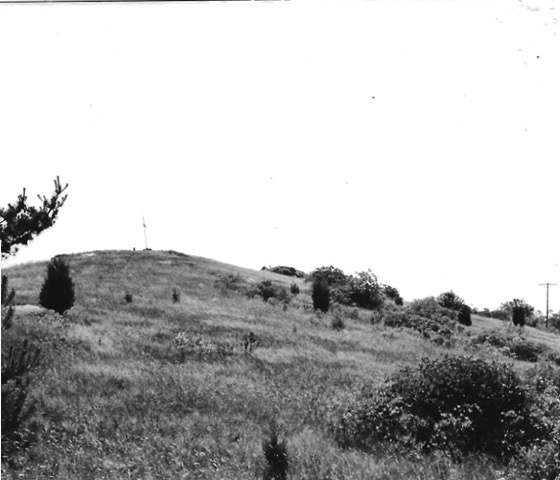
What was the Butts Hill Fort like before Roderick Terry saved the property in 1923? Around 1900 Benjamin Hall owned the fort land at Butts Hill. He seemed to own a good portion of Portsmouth land. The 1914 Portsmouth tax book has him owning (beyond his own residence and estate) the Orswell land, the Baker land, Fort land, Greene land, Ogden land, Dyer land, George Hall land, Copper Works, house lots, Davol Place, Willow Lane, and lot 25 Ocean View. There were rumors that he would sell the Butts Hill Fort land to the state for a park, but what he had in mind was selling it as 200 house lots! Images from Jim Garman’s collection help us to visualize the land at this time.
Vintage photos originally in John Pierce Collection.
For Portsmouth School Department officials, the dedication of Portsmouth High School on July 25, 1964 was the realization of a thirty year dream. As a parent of four graduates of Portsmouth High School, I never realized how difficult it was to establish a high school in Portsmouth. In reading newspaper accounts from the period, I have come to understand that those on the school board really had to fight for the establishment of the school.
The effort began in 1931 when land was offered to the town by Governor William H. Vanderbilt to build a high school for Middletown and Portsmouth. When Portsmouth students graduated from eighth grade, the town provided tuition for their students to go to Rogers High School in Newport or another school. The amount of tuition Portsmouth paid for a public high school could also go toward tuition for those who wished to attend parochial or private schools. Parents who wanted that tuition to send their children to schools like St. Catherines or De La Salle Academy in Newport were opposed to the foundation of the high school. It is interesting that arguments for public funding of private education are still made today. At that time neither Portsmouth nor Middletown was interested in establishing a high school. Interest began to develop when Newport warned that they wouldn’t accept Portsmouth students after 1960. In a special election in 1954, voters in Portsmouth rejected a plan for a joint school with Middletown and Tiverton.
In 1958 the Portsmouth School Department began to look into the issue again. Portsmouth voters rejected establishing a school and opted to create a 9th grade in town and send upper class students to Warren High School. Portsmouth began to plan for what to do with their secondary students. A 13 member study commission was named and a professional consulting service was hired. When Warren barred Portsmouth students beginning in the fall of 1962, the town developed an urgency to solve the problem. In June of 1961 voters began to fund and plan for the high school. Land was purchased adjacent to the Fort Butts School. The newly built and enlarged Fort Butts School would become part of the high school. What remains of Fort Butts School is known as the E Wing today.
High School students attended double sessions at the Fort Butts School until on November 23, 1963 the West Wing was opened and double sessions were no longer needed. This memorable day was also the date of the assassination of President Kennedy, so the first flag to fly that day was lowered to half staff. Portsmouth High School was at that time a six year, Junior-Senior High School. Even as the high school opened, there were predictions that a new school was needed. By 1970 plans were in the works to build a middle school.
Resources: Much of the information came from Newport Daily News articles from the 1950s to 1965. The issue of July 25, 1964 about the school dedication was particularly helpful.
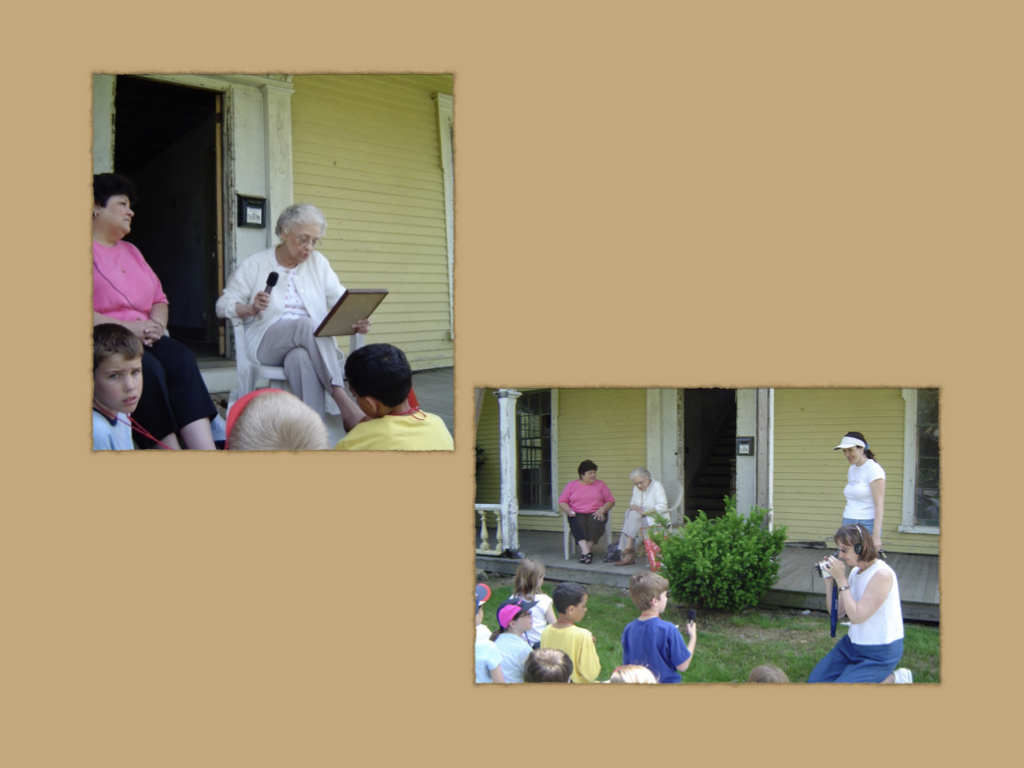
I was looking through a box of memories from my days at Elmhurst School. There were CDs with an oral history done around 2002. My third grade students interviewed the Camara Sisters, (Mary Lou Lemieux and Geri Leis) about their childhood on Glen Farm. These same students the next year used the interviews to create a video calling for the restoration of the Leonard Brown House. This is the first of the videos – about the people on Glen Farm. The ladies endured interview questions from four different classes and often there were several versions of the same story. It is raw – it is a work product and not a finished product, but as a historian I believe that oral histories are very important to understanding life in the past. Both of the ladies are gone now, but their stories remain with us through their interviews.
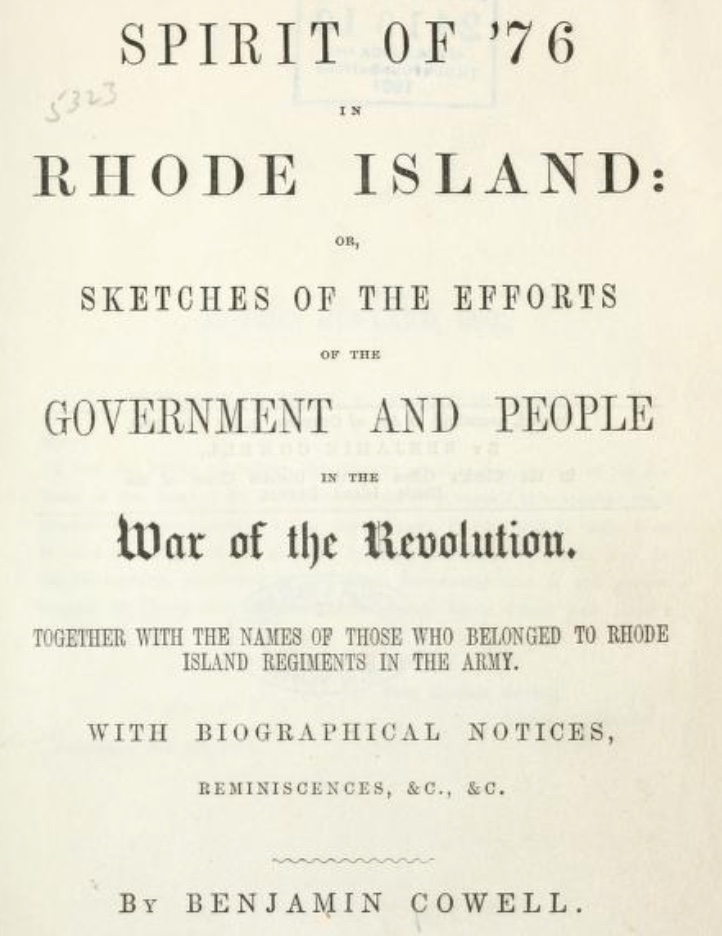
In researching another topic in Revolutionary Rhode Island, I came across a book by Judge Benjamin Cowell. Cowell was born in 1781, so he wasn’t a Revolutionary War Veteran, but he made it his aim in life to help Rhode Island veterans get their pensions. He began recording the stories these old soldiers had to tell to justify their service. Cowell began to gather eyewitness accounts, speeches, letters, rosters and every piece of information he could find on Rhode Island’s role in the War for Independence. In 1850 he gathered all this material into a book: Spirit of ’76 in Rhode Island. I am gradually making my way through this book, but I found a Portsmouth story to share.
Cowell introduces the story this way (he refers to himself as “the writer”: “In the summer of 1849, the writer reconnoitered the battle ground on Rhode Island to ascertain any interesting facts which might be within the recollection of any of the old inhabitants in the neighborhood; and in his researches, he called at the house of Mr. Seth Anthony, an aged “Friend” who now lives on the farm where the battle took place, and always lived in the neighborhood. From him he gathered no little information, and from questions which the writer put to him he received a few days afterwards the following reply, which deserves a place in these sketches.
Portsmouth, Oct 13, 1849. To Benjamin Cowell, Providence, Respected Friend, —In answer to thy questions I have to say, that I was about twelve years of age at the time of Sullivan’s expedition against the British, and lived with my father on the west road on the Island, about two and a half miles from Bristol Ferry, lived there all the time the British were in possession of the Island, and I have now, although eighty-two years of age, a distinct recollection of most of the events that took place, at least in our neighborhood. The battle on the 29th of August, 1778, took place on the farm on which I now live, which is a little to the westward of the house where my father lived; there had been skirmishing all day, but the principal fight was a little northward of “Anthony’s Hill.” (Note that we call it Almy’s Hill.) Before the American troops came on the island, the British had fortified Butt’s Hill, one of their Generals (Smith) quartered at my father’s house, the Hessians quartered in the Friends’ Meeting House on Quaker Hill. After General Sullivan came on, the enemy retreated towards Newport, and I recollect General Greene took up his quarters at my father’s house.
Almy Hill Battle Site – Garman photo
When the enemy came back on the 29th, while Gen. Greene was eating his breakfast, our house-maid said to him, the British would have him; he observed very cooly “he would eat his breakfast first;” after he had done he went to his troops. During the day some Hessians entered our house, and plundered every thing they could,— they took my father’s silver knee-buckles; I saw one of them take hold of my father and demand his money and threatened his life, but he did not get it; my father had about two thousand dollars in gold and silver, but he had taken the precaution to bury it under an old stone wall. The Hessians also searched my mother’s pocket, turned it inside out, but there was no money in it. My father and mother were “Friends,” and we kept silence as to our political opinions. I remember Gen. Green once observed that his mother was a Friend, and was opposed to his going into the army, but she said “if he would go, to be faithful.” There appeared to be fighting all day, sometimes one side would drive the other and then be obliged to retreat. But as far as I could judge, the main armies did not fight. It appears to me the events of that day will always be fresh in my recollection.
I also remember the great storm some days before the battle, I never knew so severe a storm before; it lasted several days, and did a vast deal of damage. The day after the battle the Americans all left the Island. And I also do distinctly recollect that the day after the fighting the British determined to burn all the houses in our neighborhood, and would have done it if the Americans had not left the Island that night.- We had this information from the British Officers.. (Signed). Seth Anthony
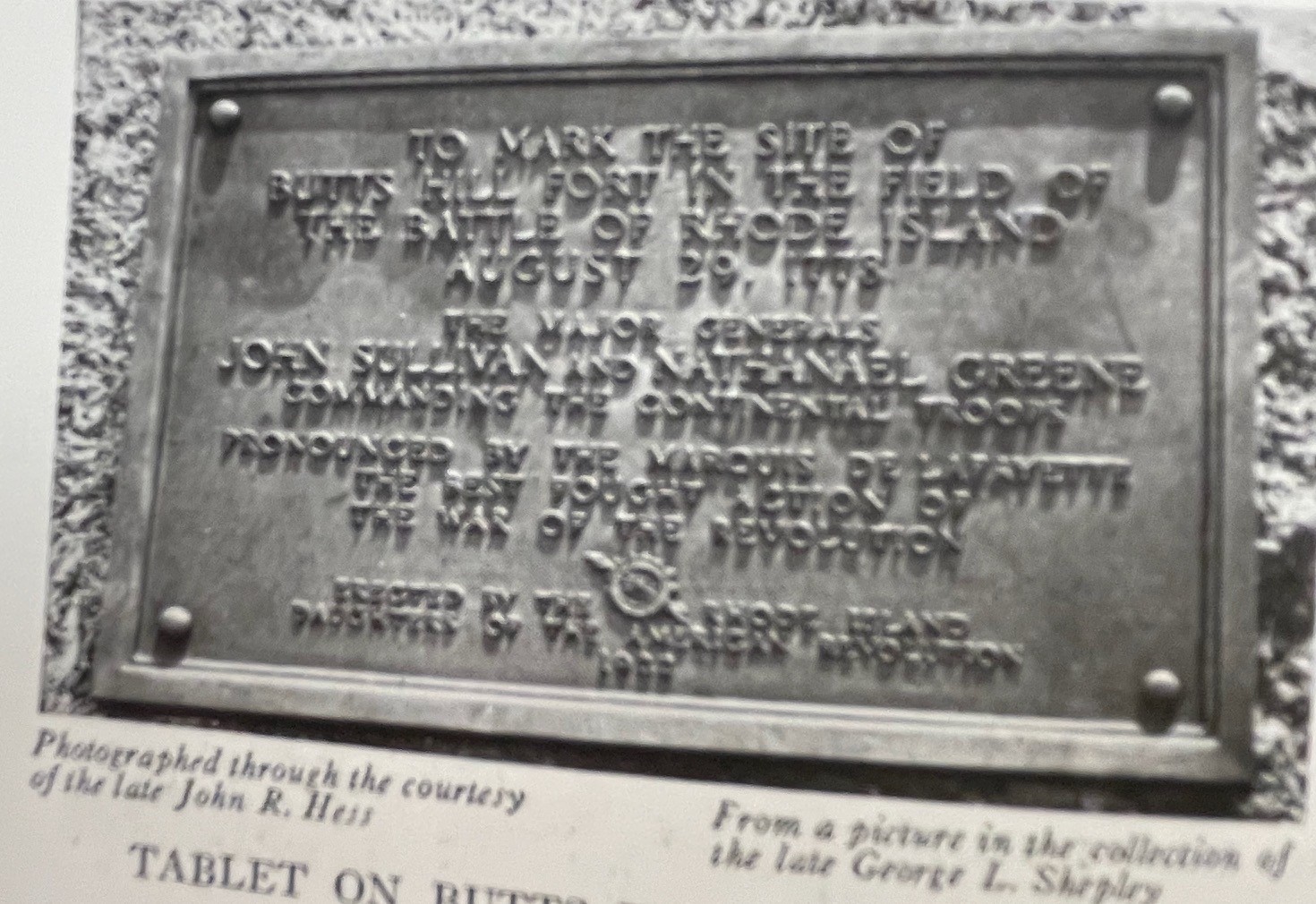
In a corner of Butts Hill Fort there is a boulder that obviously once held a plaque. The Butts Hill Fort Restoration Committee is diligently working on clearing the area around the boulder and there are hopes of restoring the plaque or making a facsimile to restore the memorial to its intended tribute. Today the original memorial is damaged and in the protective custody of the Portsmouth Historical Society. We know what it looked like in its prime.
A 1925 book “France and New England” by Alan Forbes and Paul Cadman, prominently mentioned the plaque and features an image of it. (1)
“Butts Hill Fort, on the east road between Tiverton and Newport and in the township of Portsmouth, on the north end of the island of Rhode Island, has been permanently associated with Lafayette by placing at the southeast corner of the earthworks a native boulder, on the face of which is a bronze tablet, the inscription reading as follows:
To mark the site of
Butts Hill Fort in the Field of the Battle of Rhode Island
August 29, 1778
The Major General
John Sullivan and Nathanael Greene
Commanding the Continental Troops
Pronounced by the Marquis De Lafayette
The Best Fought Action of
The War of the Revolution
Erected by the Rhode Island
Daughters of the American Revolution
1922
Even before Rev. Roderick Terry purchased the land that encompassed Butts Hill Fort, the Daughters of the American Revolution (D.A.R.) were honoring the fort on the one hundred and forty-fourth anniversary of the Battle. Newspaper accounts at the time report that two hundred and fifty people gathered on August 29, 1922 to unveil a tablet that “commemorates the battle on August 29, 1778 when sturdy Americans under Gen. John Sullivan fought the best planned battle of the Revolution.” (2)
The unveiling drew members of the D.A.R. from all “corners of Rhode Island and neighboring states.” (Newport Mercury). Other organizations took part in the ceremonies as well. Portsmouth Girl Scouts gave the bugle call and sang the “Star Spangled Banner.” Invitations were sent to the Sons of the American Revolution, Rhode Island Historical Society, Newport Historical Society, Rhode Island Citizens Historical Society, Bristol Train of Artillery, Sons and Daughters of the Puritans and Quequechan Chapter from Fall River. The public was invited to attend. (3)
After the unveiling, prayers and speeches, the guests were treated to a basket lunch at the Sprague Street home of Mrs. D. Frank Hall. It was the Hall family that owned the fort property before Rev. Terry bought it and put it into the care of the Newport Historical Society.
The Lafayette quote “The best fought action of the War of the Revolution” intrigued me because I have been researching the Marquis’ role in the Rhode Island Campaign. This quotation is widely attributed to Lafayette, but I could not find a confirmation in any of his letters of the time. Lafayette missed most of the action in the Battle of Rhode Island because he was sent to Boston to persuade the French fleet to come back to Newport. He did however, lead the last of the American troops to safety in Tiverton. He greatly admired Sullivan’s skill in executing a well planned retreat.
Sources:
Forbes, Aland and Paul Cadman. The French in New England. Boston, State Street Trust, 1925.
The DAR Monument on the grounds of the Portsmouth Historical Society gives us an opportunity to tell the story of the Battle of Rhode Island. Last Thursday night I was serving as a docent at an open house and guests asked me about the monument. A few years ago I would have taken a few moments to mention it marked the site of the first skirmish in the battle, but now I know a little too much about the Battle. The current thinking is that the skirmish on West Main and Union started earlier. Action was going down East and West Roads simultaneously.
Nevertheless, it gave me an opportunity to share the story with people who had frequently passed the monument but had not known about the Battle. Sharing that story is exactly what the Daughters of the American Revolution had in mind when they erected it in 1910 on the 132nd Anniversary of the Battle.
Battle of Rhode Island Memorial at PHS
A newspaper article from that time recorded that ” the exercises took place at 4 o’clock – the 3:20 (trolley) car from Newport taking out a large number. Some came in automobiles, others in carriages and when all had assembled there were fully 100 or more people on the ground.” Reverend Loucks of the Christian Union Church had granted permission for the monument to be placed at the southwest corner of the church yard. The Colonel Barton and the William Ellery Chapters of the DAR intended to place it “in a very conspicuous place it will attract the attention of passersby.” No local fieldstone was suitable, so the monument was constructed from a “magnificent specimen of Westerly granite instead.”
The Hon. William Paine Sheffield (U.S. Congressman from RI 1st district) gave the address. He recounted that at the corner of Union and East Road, the British forces were split (some going down Middle Road and others down East Road). “The patriots under Col. Livingstone. ‘sprung from behind the walls of this field and poured a storm of bullets upon the bewildered enemy, reloaded and repeated the desolating fire before the British could recover from the shock.’ A terrible slaughter ensued.”
Sheffield went into the background of the French Alliance, the Siege of Newport and the necessity of the orderly retreat. Understanding that background is the only way one could understand what had taken place. This was a complex situation. Sheffield quoted Lafayette on his experience of the Rhode Island Campaign: “Lafayette, on his visit to Rhode Island in 1824 told the late Mr. Zachariah Allen as he rode with him in a carriage across the border from Connecticut ‘In this state I have experienced more sudden and extreme alternations of hopes and disappointments than during all the vicissitudes of the American war.”
What were the “extreme alternations of hopes and disappointments” Lafayette experienced?
Hope: After two years of British Occupation, the French fleet arrived to aid the Americans on August 8th.
Hope: The American army continued to advance toward Newport. Lafayette and General Greene brought the American army from Tiverton to Aquidneck Island. The British retreated from Portsmouth. The hope was that between the American army and the French Navy that Aquidneck Island would be free from British occupation.
Disappointment: August 11-13, 1778 a major storm damaged the French fleet and by August 22 the fleet left for Boston to undergo repairs.
Disappointment: The alliance between the French and Americans deteriorated as Lafayette attempted to be a bridge between the two allies. Lafayette rides to Boston to meet with French Admiral D’Estaing.
Disappointment: American General Sullivan and his officers make the decision to retreat.
Hope: Americans valiantly hold back the British forces as they make a retreat to Tiverton. There are losses, but the Americans save men and equipment to fight another day.
Hope: Lafayette returns in time to bring the last American forces off Aquidneck Island.
Disappointment: Lafayette regrets he missed the fight.
These hopes and disappointments are from my research. These events are mentioned in Sheffield’s address, but the labels of Hopes and Disappointments are mine.
Sheffield ends his address congratulating the chapters of the Daughters of the American Revolution for “marking this scene of patriotic valor..” The monument is unveiled and the inscription is revealed. “In memory of those patriots who fought here in the first skirmish of the Battle of Rhode Island, August 29, 1778. Erected by the William Ellery and Colonel William Barton Chapter, Daughters of the American Revolution.”
After the unveiling, the Star Spangled Banner was sung and participants gradually made their way home. The newspaper report comments. “There was nothing then to remind one of the strife which had taken place on that spot so long ago, everything seemed so peaceful.”
Resources: Click below to read a transcription of the 1910 newspaper article on the dedication. Transcription by Portsmouth Historical Society.
Do you have an ancestor who served in Rhode Island during the War for Independence? As a local historian I relish information on those who fought right here in Rhode Island. It is good to have lists of what militia companies or regiments fought, but the individual stories of the soldiers can bring to light pieces of history we otherwise would not find. For example, military records of individual soldiers led me to stories about militia support for the French engineers at Butts Hill Fort and the experience of prisoners of war imprisoned in England.
I am starting a database of soldiers who served some time in Rhode Island during the Revolutionary War. A few people have already given me some information on their ancestors. Yes, I am interested in those who fought in the Battle of Rhode Island, but I am also interested in those who were here with militias to help the French complete Butts Hill Fort. Each piece of information helps us complete the puzzle of what went on during these war years.
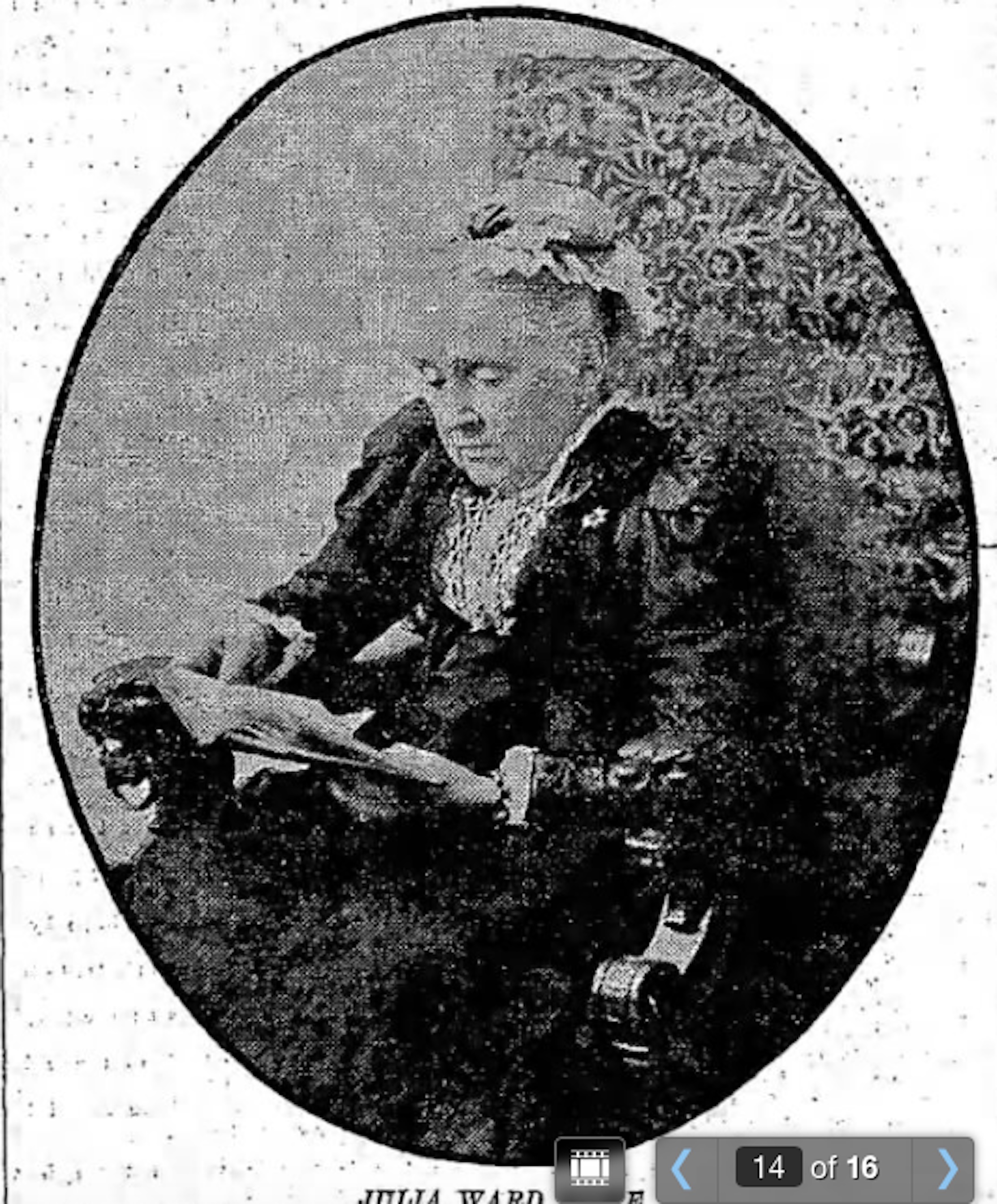
Julia Ward Howe had a famous ancestor who “served in Rhode Island.” She always felt at home in Rhode Island. She summered in Portsmouth until her death in 1910. We always include her maiden name “Ward” when we refer to her. Julia was a descendent of Governor Samuel Ward (he was also a delegate to the Continental Congress). Samuel Ward Jr, her grandfather, was one of our great heroes in the Battle of Rhode Island. That day he commanded the 1st Rhode Island Regiment (known as the Black Regiment). We have a short glimpse of what happened that day from his diary.
August 30, 1778 “The army retreated the evening of the 28th. Early yesterday morning, the enemy moved out after us, expecting that we were leaving the island, and took possession of the Heights in our front. They sent out parties in their front, and we made detachments to drive them back again. After a skirmish of three or four hours, with various success, in which each party gave way three or four times, and were reinforced, we drove them quite back to the ground they first took in the morning, and have continued there ever since. Two ships and a couple of small vessels beat up opposite our lines, and fired several shots, but being pretty briskly fired upon from our heavy pieces, they fell down, and now lay opposite the enemy’s lines. Our loss was not very great, it has not been ascertained yet; and I can hardly make a tolerable conjecture. Several officers fell, and several are badly wounded. I am so happy to have only one captain slightly wounded in the hand. I believe that a couple of the blacks were killed and four or five wounded, but none badly. Previous to this, I should have told you our picquets and light corps engaged their advance, and found them with bravery.”
If you have an ancestor who served in the Rhode Island Campaign (August 1778) or served during the period after the English left Aquidneck (Nov. 1779-1781)- let me know about them. gloriaschmidt@battleofrhodeisland.org.
We have heard of the exploits of the Sons of Liberty, but did you know the women organized into the “Daughters of Liberty?” Well before the Revolution ladies gathered in protest to the Stamp Act (1765) and the Townshend Acts (1767).
The colonies had their own taxes, but they had rarely been taxed by Britain. The Stamp Tax required Americans to pay tax on everyday items like newspapers, marriage licenses, business papers and even playing cards. The act was named for the official “Stamp” on the paper that proved the tax had been payed. The money from the taxes were to pay for the presence of British troops in America. Some of the colonists saw this as “taxation without representation” because they had no representatives in the British Parliament.
In Newport this tax was met with some violence, but the women took more peaceful strategies. Colonists still imported a great deal of goods from Britain. The women hoped that if Americans boycotted English goods that British merchants would pressure Parliament to repeal the Act. Colonial women had the responsibility of purchasing and making goods their families needed. They were willing to make the sacrifices needed to make a political statement. It gave women a voice at a time when they couldn’t hold public office. Benjamin Franklin appeared before the British House of Commons to argue against the Stamp Act. He noted that while Americans used to take pride in wearing fine imported garments, it was now their pride “to wear their old clothes over again, til they can make new ones.”
As a protest, women gathered to spin their own cloth instead of buying yarn from Great Britain. Reports of these spinning bees were mentioned in newspapers and the bees were located throughout Rhode Island. Ninety-two women gathered in Newport. The elite class of women were not used to spinning and there was a report of a seventy year old women learning to spin for the protest. The women spent the day spinning and produced 170 skeins of yarn. The group would also gather at the home of Mary Easton Lawton at Spring and Touro streets. Other prominent Newport women have been mentioned as part of the Daughters of Liberty movement – Polly Wanton, Lucy Ellery, Patience Easton, Mary Champlin and Anne Vernon Olyphant. I will be looking for confirmation of those names in further research.
In April of 1766 women gathered in Providence at the invitation of Dr. Ephraim Brown for a spinning bee and vowed they would no longer purchase English goods. Freelove Fenner was said to have organized the chapter there. In spring of 1766 twenty women gathered in Bristol, Rhode Island to spend the day spinning. Women also gathered at Daniel Weeden’s house in Jamestown, Rhode Island. These ladies were reportedly “of good Fashion and unexceptionable Reputation.” Eleanor Frye founded a unit of the Daughters at East Greenwich.
There is debate about whether there was a formal organization with chapters. Some scholars think of it as more of a movement where women saw the example of others and did the same in their towns. Newspapers were likely to label these groups as “Daughters of Liberty” if they spun and wove to boycott British goods. In 1766 the British Parliament agreed to repeal the Stamp Act, however, Parliament then passed the Declaratory Act which affirmed its right to tax the colonies in the future. They imposed the Townsend Acts in 1767 taxing imports on British gas, paints, paper and tea.
The spinners of the Daughters of Liberty considered themselves loyal British subjects, but their peaceful protest was a common experience in the colonies. The women organized boycotts of British goods and they manufactured replacement products. They pressured the men to address the taxation issue. Samuel Adams would say later: “With ladies on our side, we can make every Tory tremble.” This issue of taxation continued as a grievance. One of the grievances against the British listed in the Declaration of Independence was “For imposing Taxes on us without our Consent.”
Resources:
Photo of Woman with Spinning Wheel (Library of Congress)
From EnCompass (online) Women’s Response to the Stamp Act by Rebecca Marisseau