The Sons of the American Revolution from Rhode Island and Massachusetts traveled by trolley and boat in August of 1902 to remember those who fought in the Battle of Rhode Island. The first order of business was a call to assembly and raising a large American Flag at the top of the hill. One speaker shared a letter written by Col. Sidney Coleman on the day after the battle. This letter was passed down in the family of St. Paul’s rector Rev. J. Sturgis Pearse.
Tiverton, Aug. 31, 1778
“The day before yesterday about 7 o’clock in the morning, we were alarmed that the enemy were advancing upon us, as the night before we had retreated from near the enemy’s line to the north end of the island. They began to fire upon our advance parties, who retreated, as was intended. As soon as they came in sight of our army they formed a line in order for a general attack, but seeing we were formed and our artillery playing warmly upon them they altered their disposition and a part of them moved as though they intended to attack our left flank. Our regiment was ordered out to check their approach, which I believe was only a feint to draw our attention, as very soon afterward they advanced upon our right and made three attempts to gain a small eminence on which was a redoubt, but were as often repulsed.
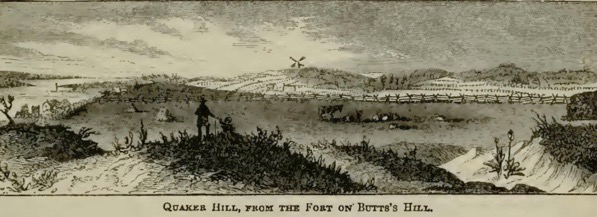
The fire continued from about 8 o’clock til 1 o’clock, a great deal of the time being pretty warm. Then again they moved to our left, when the other three regiments of our brigade were ordered to move forward in a line with us, and General Tyler’s brigade of militia upon our right. Whether they were tired of the business, which I believe to be the case or whether they disliked our disposition, I cannot tell; at all events they did not see cause to advance, but retired to the top of Quaker Hill, about one mile in front of outline. The cannonade continued until dark. Yesterday we made sundry attempts by small parties to draw them into action, but could not. Last night the general ordered the army to retreat across the river, which we did with the greatest regularity, and completed the crossing of the troops by 2 o’clock in the morning without the enemy discovering the least of our intentions. Tomorrow morning we march for Providence.”
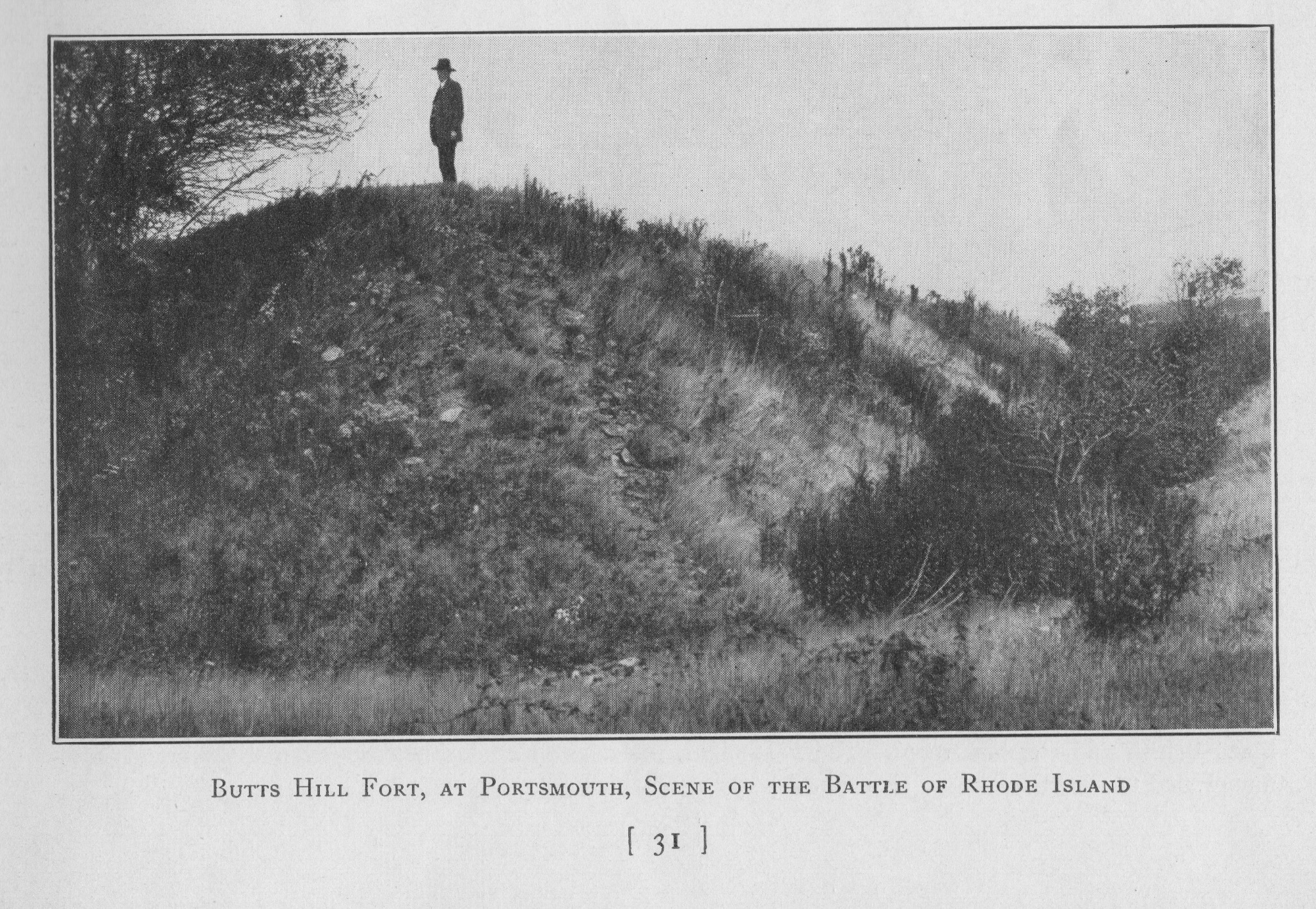
At the end of festivities “Everyone then scattered about the fortifications and viewed the surrounding country from all sides.” They marveled at the engineering required in the building of the fort.
The celebration moved to Island Park and the feast of a clam bake.
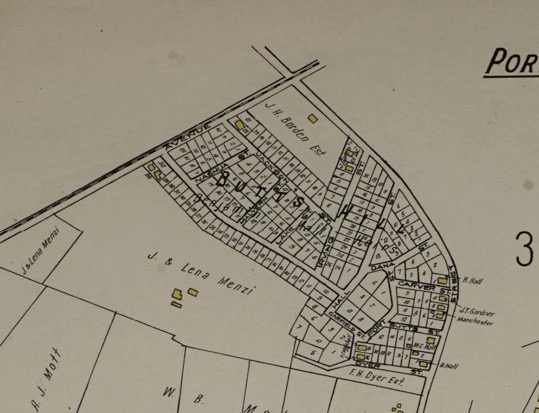
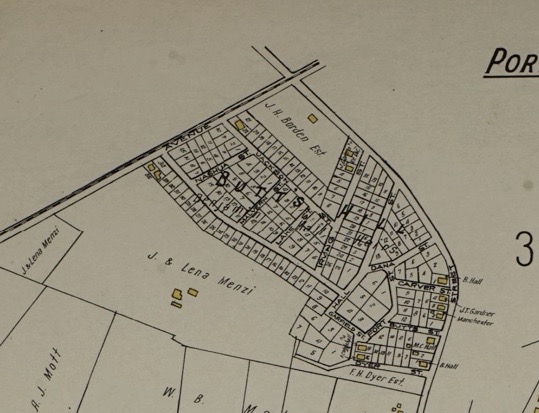
There would be no Butts Hill Fort to preserve and restore if the Reverend Roderick Terry hadn’t bought the site and the lands around it in the early 1920’s. Insurance maps were printed showing the 200-lothousing development and the Newport Mercury ads touted the site as “the most desirable place for a country home in the north end of the island.
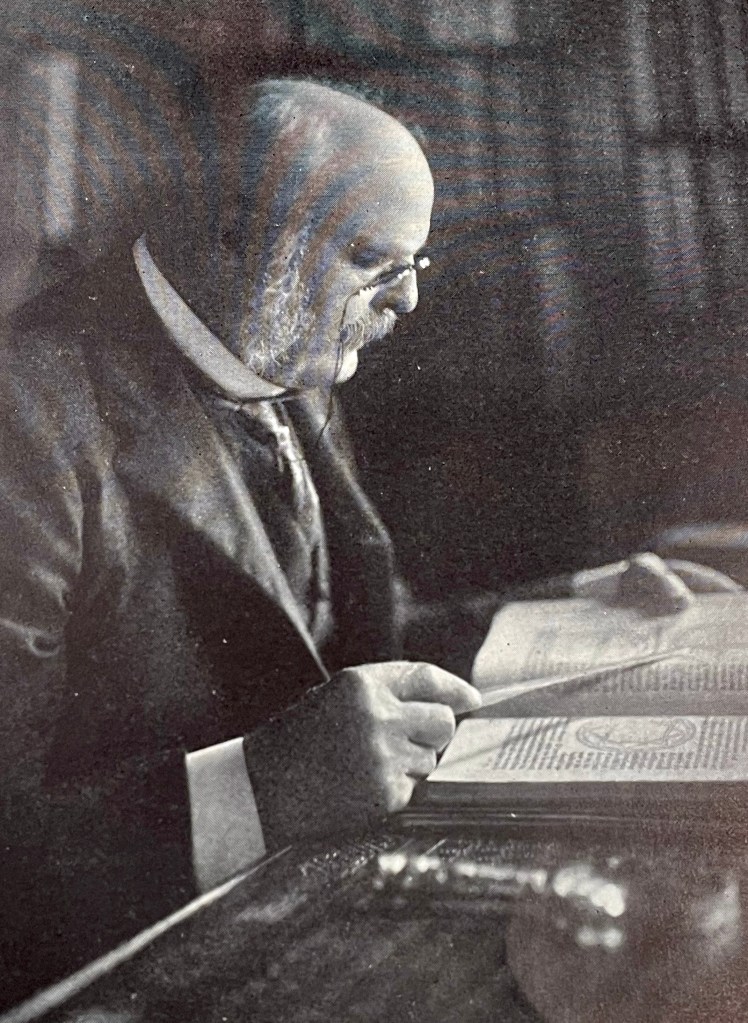
Rev. Roderick Terry
Who was Roderick Terry and how did he come to buy the Butts Hill Fort land? Terry was born in Brooklyn in 1849. His father was a wealthy businessman active in the railroad and telegraph industries. He graduated from Yale in 1870 and then he went on to study for the ministry earning a doctor of divinity from Princeton in 1881. He served as a minister in New York City for 24 years before retiring to Newport in 1905. Terry and his wife settled in a home owned by his wife’s family on Rhode Island Avenue. He had an active retirement. He volunteered his services (and his money) to organizations such as the Red Cross, Redwood Library and the Newport Historical Society. In 1918 Roderick Terry became the president of the Newport Historical Society and he was a dominant force in a renewal of that organization. His generosity rescued Butts Hill Fort, Fort Barton and the Sherman Windmill. Bu
Terry donated Butts Hill Fort to the Newport Historical Society, but he did so with strings attached.
1. The Newport Historical Society and its successors were to forever “preserve, keep and maintain” the property as a monument to those who fought in the Revolutionary War.
2. That the property will always keep the name “Butts Hill Fort.”
3. That the property should never be used for monetary gain.
Terry went on to stipulate that if the Newport Historical Society did not maintain the property, the State of Rhode Island had the right to step in and take it over. Terry turned over tracts of the Butts Hill land in 1923, but by 1968 the State of Rhode Island took over the land and placed it in the hands of the Town of Portsmouth. The town is still required to “preserve, keep and maintain” the property, to call it “Butts Hill Fort,” and to not use it for monetary gain.
The Butts Hill Fort Restoration Committee of the Portsmouth Historical Society is making an effort to follow through with Terry’s desires. Hopefully Portsmouth residents can see the value of restoring and maintaining our historic sites and landscapes. We may not have the resources that the Reverend Terry had, but we can contribute to the work and the funds to make Terry’s dream for Butts Hill Fort a reality – a place where families can come and remember the sacrifices others made for us to have a free country. It can be a place where families can enjoy walking the trails around the earthenwork fort and appreciate that in Portsmouth we still have history we can see.
Are you interested in applying your time and talents to the effort to preserve and restore Butts Hill Fort?
Volunteering/further info can be addressed to Seth Chiaro
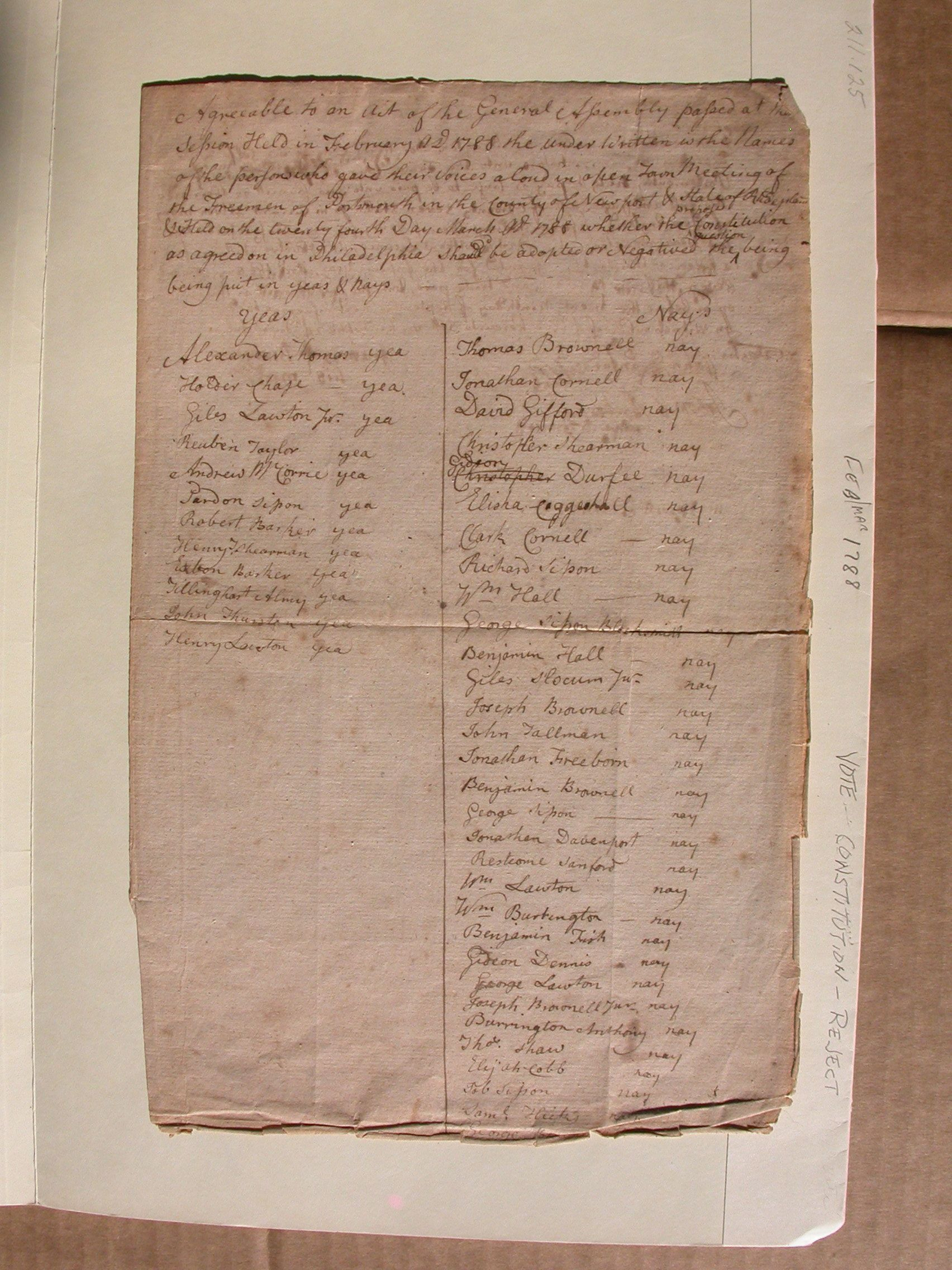
In 1779, when the town meetings began again, Portsmouth citizens sent a message to the Rhode Island General Assembly asking that their taxes should be lowered because the town was in a “Distressed Situation.” Unfortunately the state still wanted its taxes and in May of 1781 threatened to confiscate the property of those who did not pay even though they had supported the war and suffered from the hardships of occupation. Portsmouth people were so concerned about their local issues, that it was hard for them to sacrifice anything more for the state or national government. The citizens preferred the more decentralized Articles of Confederation to the new Constitution that was proposed. Portsmouth Freemen voted twelve to sixty to not adopt the Constitution in a vote held May 24th, 1788. Portsmouth military leaders Cook Wilcox, David Gifford and Burrington Anthony were among those who voted against adoption of the Constitution. As an agricultural community, Portsmouth people were concerned about war debt repayment and “paper money” issues as well as waiting for the adoption of the Bill Of Rights. Portsmouth townspeople began to favor the new constitution when it seemed that the national government would start putting heavy fines on Rhode Island trade with other states. That would not be in the best interest of the Portsmouth farmers. Portsmouth voted for the Constitution and Rhode Island finally became the thirteenth state in 1790.The 1790 census showed a thousand, five hundred and sixty residents – 243 families and 19 slaves.
Resources: Localism in Portsmouth and Foster during the Revolutionary and Founding Periods by WILLIAM M. FERRARO. Rhode Island Historical Society, August 1996.
The occupation had taken its toll and right after the War for Independence, Portsmouth farmers needed to focus on their own interests. To make good their losses, Portsmouth families petitioned the state for compensation for the damages suffered during the War. Among the documents in the collection of the Portsmouth Historical Society is such an inventory of losses dated around 1780. Robert Binney (Benney) and Elizabeth Heffernan were “in laws” who shared a home and a 26-acre farm just north of the Quaker Meeting House. The household inventory that they prepared can give an idea of what Portsmouth residents lost in the War. Among the items destroyed were five acres of orchards, a mare and 5 hogs. They lost their corn crib, four acres of corn, 12 loads of hay, twelve goats, two cows and one calf, a jackass and a ox cart among other household items.
To read a transcription of the whole inventory of household losses, click the manifest link.
The Portsmouth Historical Society has a rich collection of documents dating from the 1600s and 1700s, but we have very few documents from the Revolutionary War Era. War came to Portsmouth on December 8, 1776 when the British forces landed at Weaver Cove and they occupied the town until their forces left on October 25, 1779. Among the few documents that we do have, the name “David Gifford” is prominent. Gifford was a local ferry man and tavern owner. He took a leading role in the pre-war militia activity, he served as a Deputy from Portsmouth during the war, and state records show that he participated in military and naval activities during the war.
From its start Portsmouth traditionally had a militia. As war threatened in 1774, the Rhode Island General Assembly ordered monthly drills of all militia companies with full preparations for war. Since 1772, David Gifford had already been transporting town records and other items to and from Providence with his ferry boat. As the threat of war increased, the town records show that on August 29, 1775 the town voted “that David Gifford Draw the sum of Eighteen shillings out of this Town Treasury . . . for bringing . . . this Town’s Proportion of Powder & Balls from Providence.”
In the opening stages of war in 1775, Portsmouth raised a company of around sixty men to march to the support of Boston with a regiment raised in Newport County. A group of militia remained on guard at the town while the others were gone. Portsmouth created the fourteen-member volunteer “Artillery Company,” and provided it with 115 pounds of powder, 184 pounds of lead and 739 flints (spark making rocks). These local minutemen were to “March out to Action” when needed, and when they became part of the 1st Rhode Island Regiment in 1776, the Colony of Rhode Island provided cannons on carriages. In August of 1775 its leaders were Captain John Earl, Lieutenant James Peckham, and Ensign Cook Wilcox. Later artillery company leaders were David Gifford and Burrington Anthony. By the end of the Revolution almost all Portsmouth men from ages sixteen to sixty had served in the military.
The assembly in Providence called for additional troops and David Gifford was appointed to dole out the bounty of forty shillings to be paid to those who enlisted. Portsmouth was receptive to the calls for additional troops. Town records show that on September 17, 1776 the freemen voted that “seventeen able bodyed men be Enlisted into the servis of this State being the Town’s proportion, and that forty shillings Lawful Money be paid for every such person so Inlisted if they provide themselves with Arms & Accoutrements and that Capt. David Gifford provide the Money for said use & that he be Repayed out of this Town’s Treasury as soon as possible.”
By February 1776 the town meeting ordered their town council to draw up a list of people in town who could not provide their own firearms. The freemen voted 240 dollars or 75 pounds lawful money to purchase firearms. A committee of four men was assigned to get the money and purchase twenty small arms. David Gifford, one of the committee was selected to receive the weapons.
When the British and Hessians arrived in December of 1776, there were citizens who fled to Tiverton or Bristol. It is likely that David Gifford and his ferry boat left the island. In December of 1776 Rhode Island Records state “It is voted and resolved that Capt. David Gifford be permitted to proceed with a flag of truce to Rhode Island, under the direction of His Honor the Governor, upon his procuring three prisoners of war to exchange for three soldiers lately belonging to his company, and now detained as prisoners on said island.” It would be interesting to know which three of his Portsmouth militia company were part of the exchange.
By August of 1777 he was a member of the General Assembly and he was appointed a Lieutenant in Major Munroe’s Company. Being a ferry man, he took part in naval operations as well. The April 6, 1778 journal entry of Captain Joseph Crandall of the Rhode Island Navy Schooner-rigged Armed Galley Spitfire notes that Gifford and his ferry boat took part in a raid to Bristol Ferry on Aquidneck Island where they set fire and destroyed a British sloop. This daring raid was conducted while the Americans were being fired on from the British fortifications at Bristol Ferry.
We don’t have records of Gifford being in military service during the Battle of Rhode Island or during the remainder of the war. In 1780 and 1781 he was appointed Deputy from Portsmouth. He continued to receive recruits and handle bounties for the enlisted.
David Gifford led a full life. He was active in the Portsmouth community as a tavern keeper and ferry man at Bristol Ferry. He was a militia leader who was essential in recruiting soldiers and getting the militia armed and ready for war. He was trusted with a prisoner exchange. He used his skills as a ferry man on a daring raid to burn an enemy ship. He served Portsmouth as a Deputy. David Gifford died May 17, 1790 and is buried at St. Paul’s Cemetery. He was only in his forties, but he had lived a full life of service to Portsmouth.
We are fortunate to have eyewitness accounts of the Battle of Rhode Island. One of those accounts is by Lieut.-Colonel Samuel Ward, the son of Rhode Island Governor Samuel Ward. He was born in Westerly on November 17, 1756. He graduated from Brown University in 1771. He was the grandfather of Julia Ward Howe.
Ward received his commission as Captain on May 8th, 1775. Ward was promoted to major of the 1st Rhode Island Regiment on January 12, 1777 and became a lieutenant colonel on 5 May 1779 (with date of rank retroactive to May 26, 1778). When the First Regiment arrived on Aquidneck Island, there were changes in leadership. Major Samuel Ward was given command of the First Rhode Island Regiment. The regiment was assigned to guard the abandoned British redoubt that was part of the American line. This location was to the southwest of Butt’s Hill. Ward and the Black Regiment are credited with driving back three waves of Hessian troops.
Ward’s published diary is more of an account of his military career with just a few quotations with his actual words. Fortunately the description of the Battle of Rhode Island is among the quotations.
The August 30, 1778 diary entry provides an eyewitness account: “The army retreated the evening of the 28th. Early yesterday morning, the enemy moved out after us, expecting that we were leaving the island, and took possession of the Heights in our front. They sent out parties in their front, and we made detachments to drive them back again. After a skirmish of three or four hours, with various success, in which each party gave way three or four times, and were reinforced, we drove them quite back to the ground they first took in the morning, and have continued there ever since. Two ships and a couple of small vessels beat up opposite our lines, and fired several shots, but being pretty briskly fired upon from our heavy pieces, they fell down, and now lay opposite the enemy’s lines. Our loss was not very great, it has not been ascertained yet; and I can hardly make a tolerable conjecture. Several officers fell, and several are badly wounded. I am so happy to have only one captain slightly wounded in the hand. I believe that a couple of the blacks were killed and four or five wounded, but none badly. Previous to this, I should have told you our picquets and light corps engaged their advance, and found them with bravery.”
We can make some comparisons between the diary accounts of Ward and Angell. Each was with a different Regiment – Ward RI First and Angell RI Second – so they had different skirmishes to fight.
Looking at the Movements of the Rebel and British forces:
Ward reports that the army began to retreat on the evening of August 28th. Angell reports that his troops struck their tents and marched north on August 29th.
Both Ward and Angell show fighting back and forth between the Rebels and the British. Ward reports that one such skirmish lasted three or four hours “in which each party gave way three or four times.”
Both Angell and Ward tell us that the British ships were firing on the Rebel forces, but Americans fired on them and the vessels retreated.
Looking at casualties:
Ward comments “our loss was not very great” and Angell seems to report that the British had considerable losses but there were only three or four of the Rebels killed.
Looking at the retreat:
Angell tells us that the Americans retreated because of Washington’s warning about British ships heading in.
Angell also tells us more about the retreat via Howland’s Ferry. The soldiers had little sleep and little to eat. They had to “lie in their lines” that night and the crossing happened in the early hours of the morning. After encamping near the ferry they went to an area between Bristol and Warren.
Sources:
A Memoir of Lieut – Colonel Samuel Ward, First Rhode Island Regiment, Army of the American Revolution; John Ward, New York, 1875. (available on Kindle)
Laura E. Richards, Maud Howe, Florence Howe Hall, Julia Ward Howe, 1819-1910, in two volumes, with portraits and other illustrations: volume 1
Geake, Robert. From Slaves to Soliders. Yardley, Pennsylvania, Westholme Publishing, 2016.
Primary sources are what I look for when I am researching topics. Primary sources are first hand accounts. Some examples are documents, letters, maps created at the time, newspaper accounts, photographs and diaries written at the time an event took place. We are fortunate to have some diaries which record what happened during the Battle of Rhode Island. This blog will focus on entries from the diary of Col. Israel Angell. With any primary source, a researcher should answer some basic questions to set the source in context.
Who wrote this diary?
Who might have been the intended reader?
Where and when was it written?
What does it tell me about the subject I am researching.
Who wrote this diary?What do we know about him? Israel Angell was a descendant of Thomas Angell, who came to Providence with Roger Williams. He was born in North Providence on August 24, 1740. Angell joined the rebel cause from the beginning. When an army was formed by the General Assembly of Rhode Island in 1775, he was commissioned as a Major. With the formation of the Second Rhode Island Regiment, Israel Angell was elected Lieutenant-Colonel. The regiment went to join the army under Washington. Command of the regiment was given to Angell, on Jan. 13, 1777 when the Colonel in charge died. His regiment was detached from the main army and sent to Rhode Island to fight with General Sullivan in the operations against the enemy on Aquidneck Island.
Who might have been the intended reader? A diary is a very personal document and may just have been a way for Angell to keep track of what he experienced. As an officer, it may also be a record that might be consulted if he was questioned later.
Where and when was it written? These three entries are in late August of 1778 at the time of what call the Battle of Rhode Island. It reflects what was going on in Portsmouth during the battle.
What does it tell me about the Battle of Rhode Island? As you read through the diary entries, do you find information that answers some of our questions – What were the movements of the Americans and of the British? What were some of the Portsmouth locations mentioned? What were the American casualties? What happened to Angell during the battle and afterwards? Why did the Americans retreat? How did the retreat proceed?
August 29th, 1778. A Clear morning and Very Cool the ( ) Recd orders last evening to Strike their tents and march to the north end of the island; the advanced piquet was to come off at 12 oclock the enemy finding that we had left our ground pursued with all possible speed Come up with our piquet about sunrise and a smart firing begun, the piquet repulsed the Brittish troops 2 or 3 times but was finily obliged to retreat as the Enemy brought a number of field pieces against them the Enemy was soon check’t by our Cannon in coming up to our main body and they formed on Quaker Hill and we took possession of Buttses Hill the left wing of the brittish army was Compossed of the hessians who Attackt our right wing and a Sevear engagement Ensued in which the hessians was put to flight and beat of the ground with a Considerable loss our loss was not very great but I cannot assertain the number. I was ordered with my Regt to a Redoubt on a Small hill which the Enemy was a trying for and it was with Difficulty that we got there before the Enemy. I had 3 or 4 men kill’d and wounded to day at night I was ordered with my Reg to lie on the lines I had not Slept then in two nights more than two or three hours the Regt had eat nothing during the whole Day this was our sittuation to goe on guard, but we marched off Chearfully and took our post.
August 30th. A Cloudy morning and the wind very high it rained a Considerable in the night the Enemy Remained on their Ground this morning two English friggats Came up yesterday to prevent our retreat but could do but little they Still Remained here. I was Relieved this morning and got Some provisions and being much worn out for the want of sleep went to a hous and took a good knap there was a Cannonade kept up to day and Some small arms from the Sentries at night we Recd orders to Retreat off the Island which we did without the loss of anything, this Retreat was in Consequence of an Express from Genl Washington informing Gen Sullivan that the Brittish Ships of war and transports had sailed from New York Some days before.
August 31st, 1778. Our retreat off the Island was completed by three o’clock this morning it is Supos’d that the Enemy attempted a Retreat last Evening but after finding that we Had Retreated they Returned to their ground as it was late in the morning before they took possession of the forts we left …………..After we had Crost at howlands ferry we Encampt about a mile from Sd. ferry where we tarried this day at Night Rec’d orders to Strike our tents next morning and Embark on board our Boats and Land near Warren as Genl Varnums Brigade was to be stationed Between warren and Bristol. Genl Cornells at Rowlands ferry Genl Glovers at Providence Col. Comdt Green at warwick and Greenwich.
I will go through what information I gained from the diary in another blog as I compare this diary account with that of Samuel Ward from the First Rhode Island Regiment.
Sources:
Angell, Israel. Diary of Colonel Israel Angell Commanding the Second Rhode Island Continental Regiment during the American Revolution 1778-1781. Edited by Edward Field. Providence; Preston and Rounds, 1899.
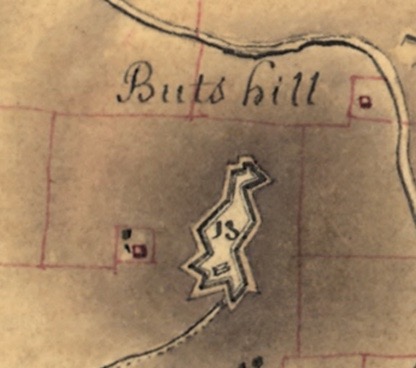
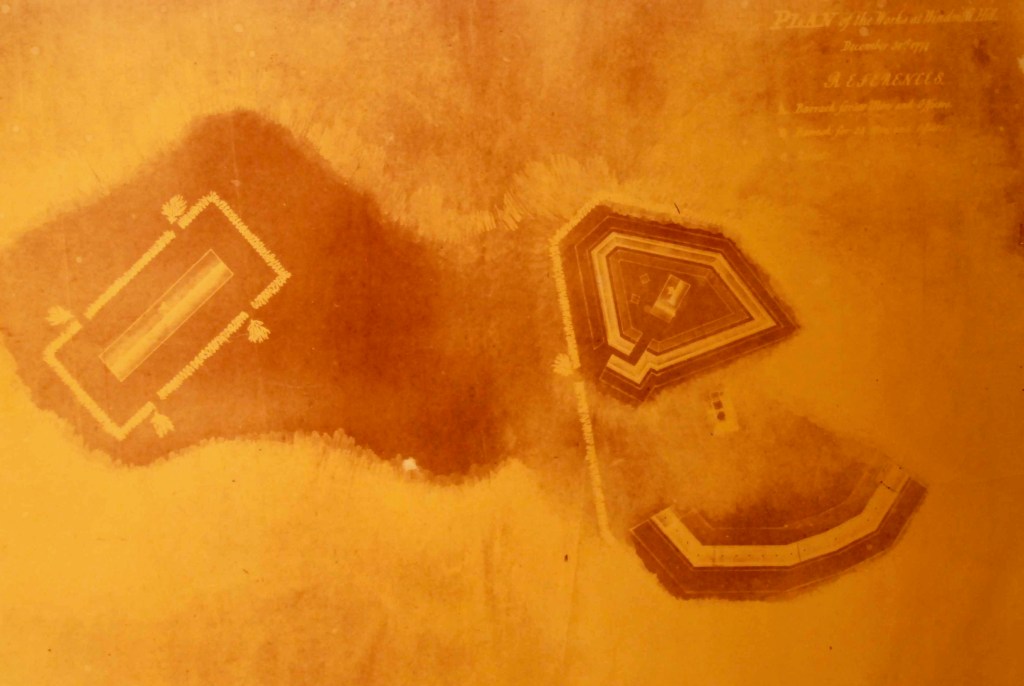
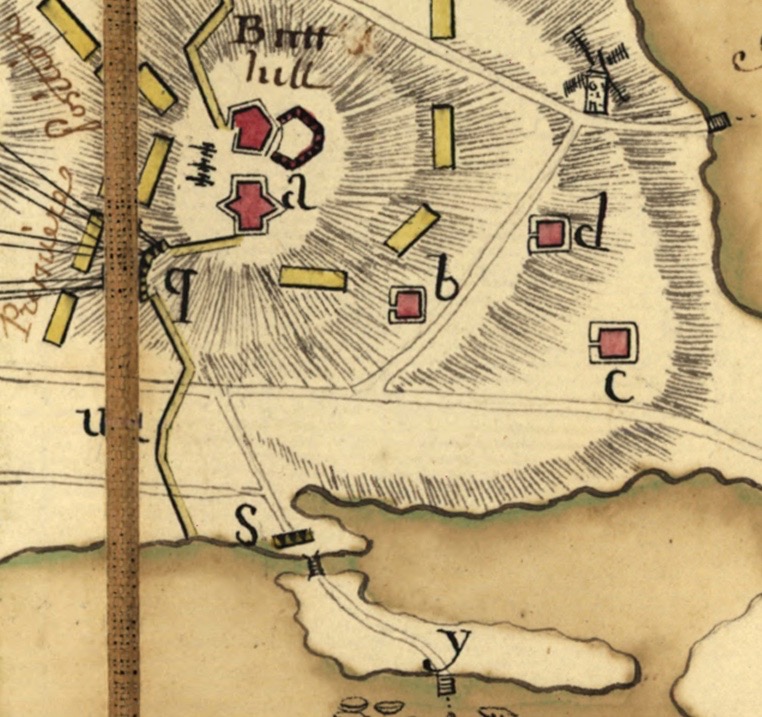
As we look to restoring Butts Hill Fort, one question that comes up is how the fort developed in the first place. The Diary of Frederick Mackenzie * in combination with the Revolutionary Era maps of the area give us an idea of how Butts Hill Fort (Windmill Hill Fort) developed over time. Military historians will have a better handle on construction methods, but the diary, maps and blueprints can help us to understand what we see at Butts Hill today.
December 8, 1776: as Mackenzie was arriving on the island as part of the British forces, he wrote: “The Rebels abandoned a well situated fort at the N. End of the Island yesterday, without attempting to defend it. It in some measure commands the passage to Bristol by the ferry.” My guess is that this is a reference to the Butts Hill (or Windmill Hill location as the British called it). The location does overlook the Bristol Ferry landing.
Dec. 30, 1776: The redoubt constructed by the Rebels above Bristol Ferry, and abandoned by them, is ordered to be repaired and a guard house to be erected therein for the accommodation of the advanced post. It is a much better situation for the advanced guard than that they are now in, and the troops on duty will not be liable to accidents from the wanton firing of the Rebels on the opposite side. This again I believe to be a reference to the Butts Hill Fort in the area “above Bristol Ferry.” The Rebels had fortifications across in Bristol and they would often direct fire at the troops stationed by the Aquidneck side of the Bristol Ferry crossing. The order here is to repair the redoubt and build a guard house.
Sept 12, 1777: As the works intended to be made for the defense of the North Part of the Island, require a good many workmen to complete them, and the duty of the Soldiers is rather severe, General Pigot sent a summons this day to the Inhabitants of the township of Portsmouth to assemble on the 15th instant at Windmill Hill in order to assist in carrying them on. They are required to work three days in the week.
Sept 15, 1777: In consequence of the General’s summons to the Inhabitants of the township of Portsmouth, to assemble in order to be employed to work on the Redouts, 17 only appeared this morning at the place appointed. The Majority of the Inhabitants being Quakers, they informed the General that it was contrary to their principles to assist, in any manner in matters of War, and that therefor they could not appear. They even refuse to be employed in constructing Barracks for the accommodations of the troops.
Sept. 17, 1777: We are at present very busy in fortifying different posts on the Island; and there are already more works planned and traced out, than can possibly be finished by the end of December. Those intended are a redoubt for 30 men and 2 cannon opposite Howland’s bridge. A fortified Barrick on Windmill hill for 200 men. A Redoubt on Barrington’s Hill for 80 men and 2 cannon. A redoubt at Fogland Ferry for the like numbers. A redoubt on Quaker Hill and a Barrack there for 200 men. A redoubt and Barrack for 60 men on Turkey Hill.
From these passages it appears the barracks at Windmill Hill were constructed beginning in September of 1777 with forced labor from the Portsmouth townspeople. Windmill Hill and Butts Hill are different names for the same area.
Nov. 11, 1777: The Barracks at Windmill-Hill go on so slowly for want of materials, that there is a prospect of the troops remaining in camp for three weeks to come.
Obviously the barracks were sorely needed but the construction was slow. Historian Walter Schroder in his book about the Hessian troops says that by the end of 1777 there was a battery with six guns at Windmill Hill as well as a redoubt for 100 men. A separate barracks for 300 men and officers had been constructed close to the other barracks. He writes: “The entire area encompassed earthworks some 700 feet long by 200-300 feet in width. Abbatis – an entanglement of cut tree limbs serving a role similar to barbed wire in modern times –had been placed outside the entrenchments and earthworks to slow down and harass advancing enemy foot soldiers. **
April 18th, 1778: As we have at present no camp equipage (except some old tents for about 500 men) I think we should immediately erect a respectable work on Windmill Hill, capable of containing a Regiment, and not to be taken without breaking ground against it. The enemy should by every means in our power be prevented from establishing themselves unmolested on Windmill Hill, or any part of the Northern extremity of the Island, for if they should we shall find it extremely difficult to dispossess them…
..A trifling temporary work should by no means be constructed on Windmill Hill; to as it is the best spot on the Island for a work of consequence, and such a work will at one time or other be found necessary there, the erection of a trifling work would be throwing away so much time and money.
It is clear that Mackenzie considered Windmill Hill (Butts Hill) and important location and thought it should be well developed as a defensive fort.
May 1, 1778: The 54th regiment are to construct a Redoubt round the Barrack at Windmill Hill, for the present security of that post.
May 5, 1778: The 54th Regiment is employed at Windmill Hill in throwing up a work round the large Barrack there.
Here it seems like there is a defensive perimeter built around the Barracks and guard House. This gives it the outline that we can even see today.
May 8th 1778: The regiments of Landgrave and Ditfourth to be posed at Windmill Hill; under the Command of Major General Losbert. They consist of near 1,000 men, their field pieces would be of great service there, they may be depended upon for the defense of the works. And Major General Losbert is the Second in Command on the Island.
It is hard to imagine a thousand soldiers at the fort. Some would be in the barracks and some would be encamped around it.
1780, July: The French arrived on Aquidneck Island. Before they had settled, there was news the British were planning to attack. Washington authorized Rochambeau “to call up the militia of Boston and Rhode Island to aid his army build the works for the defense of the island.”
The Black Regiment was split between guarding munitions in Providence and guard duty on Aquidneck Island. Sixty-four members of the regiment were sent to Newport and were incorporated into the “Rhode Island Six Months Battalion.” The Black Regiment veterans were among the 600 men encamped in Portsmouth guarding Butts Hill Fort, Howland Ferry and Bristol Ferry. One white recruit, Peter Crandall, wrote: “We landed on the north end of the island near Butts Hill Fort and pitched our tents on a height of land near Butts Hill Fort …. our duty was to go through the manual exercise, keep up quarter guard, and work on the fort.” This remnant of the Black Regiment and The Six Month Battalion were there until Nov. 1780. They remained at Butts Hill to work on the fort after the remainder of the Continental Battalion joined French troops in marching to join Washington’s army. *** In the summer of 1780 they connected the redoubt and the former British barracks into one structure.
From French map 1780
British (Fage) 1777
French map 1778
Sources:
*Diary of Frederick Mackenzie Vol. 1 and Vol. 2. Cambridge, Massachusetts, Harvard Press, 1930.
**Schroder, Walter. The Hessian Occupation of Newport and Rhode Island 1776-1779. Westminster, Maryland, Heritage Books, 2005. pg. 102.
***Kopek, Daniel M. They “fought bravely, but were unfortunate:” The True Story of Rhode Island’s Black Regiment.
Edward Fage – Plan of the Works at Windmill Hill, Dec. 31, 1777 (facsimile in PHS collection)
Plan de Rhodes-Island, et position de l’armée françoise a Newport. Library of Congress Collection.
Plan de Rhode Islande, les differentes operations de la flotte françoise et des trouppes Américaines commandeés par le major général Sullivan contre les forces de terre et de mer des Anglois depuis le 9 Aout jusqu’a la nuit du 30 au 31 du même mois que les Américains ont fait leur retraite 1778
During the War for Independence the hill that was known as Butts Hill or Windmill Hill became the location of Butts Hill Fort. The location provided a commanding view of the Eastern and Western sides of Aquidneck Island including East Main Road and West Main Road. It was a prime location for defensive fortifications.
North view from Butts Hill (postcard from PHS collection)
1776 – Americans built small battery at Butts Hill.
1776 – December 8th. British occupation of island begins and American forces escaped via the ferries. British forces take over the battery at Butts Hill.
1777 -September: British General Pigot forced Portsmouth residents to work three days a week on the construction of the earthworks that remain today. Butts Hill Fort became the most important position because it guarded locations where Patriot forces might invade the island – Bristol Ferry, Common Fence Point, Howland’s Ferry and Fogland Ferry. It was a fortified barracks for up to 200 troops.
1778 – July 29th: The French fleet was expected in Newport so the British abandoned the fort to reinforce lines around Newport. American General Sullivan and his troops were waiting in Tiverton for an opportunity to cross to Aquidneck Island.
1778,- August 9 – 11th. On the morning of August 9th during a drill for the crossing, General Sullivan discovered that the British had abandoned fortifications at Ft Butts. He sent troops across because he knew the ferries were unguarded and they could cross safely. By August 11, American troops took over Butts Hill Fort.
Edward Fage – Plan of the Works at Windmill Hill, Dec. 31, 1777 (facsimile in PHS collection)
1778, August 20th, General Sullivan hears that the French fleet had gone to Boston for repair and resupply. The Americans were shocked by this news.
1778, August 24th. General Sullivan begins to make preparations for a retreat from the island.
1778, August 29-30th – Battle of Rhode Island. The British came after the American troops to prevent them from retreating from the Island. This battle came to be known as the Battle of Rhode Island. The heights of Butts Hill Fort provided the American Commanders with a view of the battlefield – Butts Hill, Quaker Hill and Turkey Hill. Although the Americans occupied the fort for only 17 days, it was their command post during the battle. The Americans successfully retreated.
1778, September 1st. The British return to Butts Hill Fort.
1779, October. British forces leave Butts Hill Fort and Aquidneck Island. The Americans again occupied the fort, and in the summer of 1780 they connected the redoubt and the former British barracks into one structure.
1780, July: The French arrived on Aquidneck Island. Before they had settled, there was news the British were planning to attack. Washington authorized Rochambeau “to call up the militia of Boston and Rhode Island to aid his army build the works for the defense of the island.”
Plan de Rhodes-Island, et position de l’armée françoise a Newport. Library of Congress Collection.
The Black Regiment was split between guarding munitions in Providence and guard duty on Aquidneck Island. Sixty-four members of the regiment were sent to Newport and were incorporated into the “Rhode Island Six Months Battalion.” The Black Regiment veterans were among the 600 men encamped in Portsmouth guarding Butts Hill Fort, Howland Ferry and Bristol Ferry. One white recruit, Peter Crandall, wrote: “We landed on the north end of the island near Butts Hill Fort and pitched our tents on a height of land near Butts Hill Fort …. our duty was to go through the manual exercise, keep up quarter guard, and work on the fort.” This remnant of the Black Regiment and The Six Month Battalion were there until Nov. 1780. They remained at Butts Hill to work on the fort after the remainder of the Continental Battalion joined French troops in marching to join Washington’s army. **
1781, June: French troops leave Butts Hill Fort. Fort is abandoned. As Portsmouth recovers after the war, this land is unusable for agriculture and remains deserted.
1781, August: Five 18 pound guns with their carriages removed from Butts Hill to Easton Point
1783, June: RI assembly authorized sale at public auction of the gates, buildings and other installations
What happened to the land after the war is still somewhat of a mystery.
1850s Ward Map shows Butts Hill Fort, but no development of the land and no clear ownership. Butts family genealogy reveals that the Butts family moved away to Providence and other locations to practice their craft of rope making. They note that some of the land passes down through a daughter whose married name was Cook.
Civil War Era: There are reports that some militias use the fort for training purposes.
After the Civil War: Maps from the 1870s and 1885 clearly show the Fort as a prominent feature. During this time land evidence records show Charles Hicks Dyer and Charles Henry Dyer with ownership of the land around the fort. B. Hall Jr. also has a segment of Fort land.
1900: Notices appear in the newspapers for house lots for sale by Benjamin Hall Jr.
1908: The state of Rhode Island shows interest in making the land at Butts Hill Fort a state park.
Sanborn Map 1921
Circa 1910 Map
Newspaper ad 1900
1920s: Roderick Terry conveyed to Newport Historical Society, pieces of the land in 1923, 1924, and 1932.
Terry stipulated
That the fort would serve as a memorial or monument to the memory of those who fought in the American-Revolutionary War.
That said premises shall always retain the name of “Butts Hill Fort”.
That said premises shall never be used to make money.
That if the Newport Historical Society doesn’t take care of the fort, it would be transferred to the State of Rhode Island. These provisions continue to control the property to this day!
1968 the State of Rhode Island transferred the property to Town of Portsmouth.
Sources:
Butts, Francis B. “The Butts Family of Rhode Island – Genealogy and Biography” 1891
McBurney, Christian. The Rhode Island Campaign. Yardley, PA, Westholme Publishing, 2011.
Dearden, Paul. The Rhode Island Campaign of 1778: Inauspicious Dawn of Alliance, Providence, Rhode Island Publications Society, 1980.
The French in Newport – Newport Historical Society, Fall 2003-spring 2004.
Neimeyer, Charles P. The British Occupation of Newport Rhode Island 1776–1779. Army History No 74, Winter 2010.
As we look to preserving the earthworks Butts Hill Fort, I wondered about the land history. Who owned this piece of land we are trying to preserve? How has this tract of land been used throughout Portsmouth history. Finding the answers to those questions is not so easy. Although Portsmouth has kept excellent land records, my skills in tracking back ownership are somewhat lacking. Let me share what I have gleaned through maps, historical records and secondary sources. I have tried to confirm as much as I could through Portsmouth land records and genealogical records. This is a work in progress, so maybe those knowledgeable in family genealogies can help me to find confirmations or missing links.
Part 1 – From Land Grant to War for Independence
Land grant: I usually start research by looking at West’s Land Grant maps to identify the original owners. Looking at these maps led me to believe that the land was town owned for many years. I do have a confirmation of the Durfee family on that land because town records show that in February of 1729 Thomas Durfee left “a parcel called the Wind Mill Hill land” to son Gideon Durfee.
Land Grant to Durfee
1638 to after 1708: The Town of Portsmouth retained the property we know as Butt’s Hill. The Town, however, permitted a windmill to be erected so that the windmill was owned by other familiar Portsmouth families. The handing down of the Windmill and the land around it was recorded in the town records.
1657: William Cory and William Earl applied to the town council to trade a piece of land for land on Briggs Hill to build a windmill.
1665: The hill land (or pieces of it) was owned by Caleb Briggs.
1668: A windmill is erected by William Earle and William Cory. Cory is known as a carpenter and miller. Cory and Earle are brothers-in-law.
1682 (Feb 24, 1682). William Cory (carpenter and miller) in his will gave the windmill to his wife Mary. Mary traded land back to the town.
1721: Caleb Bennett inherits the windmill from father Robert Bennett. Robert had married Anne Cory. Perhaps the windmill and land came from her family.
Will – To Caleb Bennett from father Robert: Transcription of Land Evidence Record in Rhode Island Genealogical Biographies
1725 January 15, John Butts bought of Caleb Bennett the windmill and about one rood of land (about a quarter of an acre) on Windmill Hill. This I was able to confirm through Portsmouth land evidence.
Sale – Bennett to Butts – Land Evidence Records of the Town of Portsmouth
At this point the area was known as Windmill Hill or Butts Hill. The Fage Maps called it “Windmill Hill.” In the family genealogies I don’t find evidence that John Butts or his son John Butts, Jr. were millers or farmers. There was a Butts family homestead that was torn down in the 1870s. Before the War for Independence some members of the Butts family, including John Butts, Jr., were ship owners.
According to a Butt’s family genealogy: “The name of the fort was given in honor of John Butts and his family for their loyalty, and aid given patriot Army during the struggle for independence. John Butts occupied the homestead of the Butts family, and was engaged in the shipping interests of the Island. The *War of the Revolution” was a great disaster to him; the British warships captured or destroyed his little fleet of vessels and the army swept everything from his land. He was greatly respected by the people among whom he lived, and the soldiers of the Patriot Army. To his honor and patriotism the fort which they struggled to defend was named, and from that time has been known as “Fort Butts.” It is also said that the industry of the Island is largely due to his energy and influence. He married Susanna, daughter of William and Susanna Cornell, of Portsmouth, August 17, 1767.” **
Looking at their genealogies, the family didn’t seem to come back to the land at the end of the War. Family members were active in rope making not milling or farming and moved to other parts of the state.