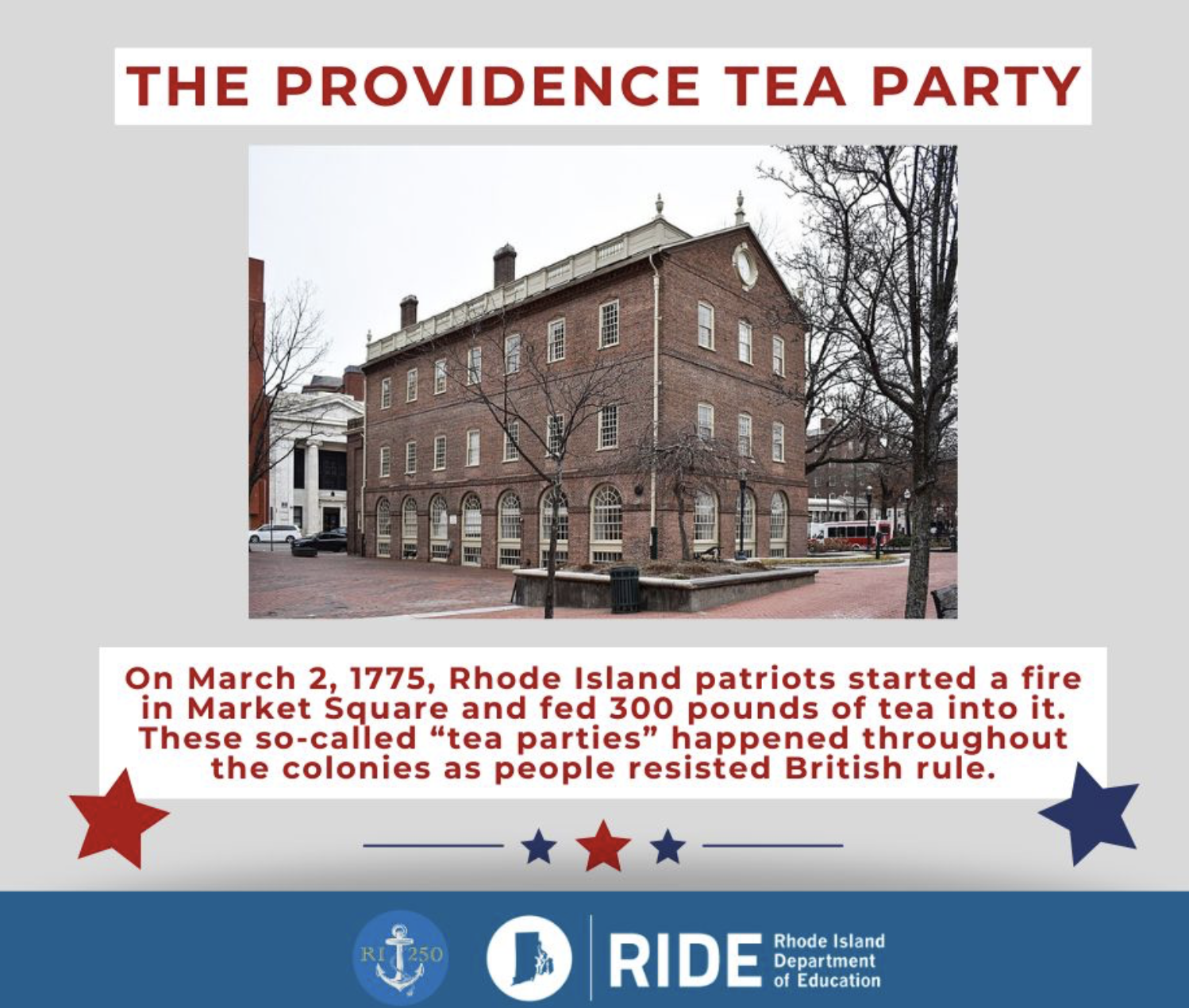
Rhode Island women were not shy about participating in protests against the British Acts that were imposed on the colony. The “Daughters of Liberty” held their spinning bees out in the open. Boston’s famous Tea Party, however, had its participants hiding their identifies with costumes. Providence women (and men) did their protests out in the open. They even announced the coming Tea protest through the Town Cryer.
On Thursday last, about twelve o’Clock at noon, the Town Cryer gave the following notice through the Town:
“At five of the Clock, this Afternoon, a Quantity of India Tea will be burnt in the Market Place. All True Friends of their Country, Lovers of Freedom, and Haters of Shackles and Hand Cuffs, are hereby invited to testify their good Disposition, by bringing in, and casting into the Fire, a needless herb, which for a long time hath been highly detrimental to our Liberty, Interest and Health. “
The crowd did gather at the Providence’s Market Place and a fire of tar was lit. Three hundred pounds of tea were cast into it as well as Lord North’s Speech and other obnoxious documents.
“Many worthy women, from a conviction of the evil tendency of continuing the habit of tea drinking, made freewill offerings of their respective stocks of the hurtful trash.”
While the tea was burning, Sons of Liberty went along the street and painted over the word TEA on shop signs. Bells tolled to celebrate the funeral of Madam Soughong – Tea from China that had found its way to America.
Why was the tea so despised? Parliament had repealed most of the Townshend duties, but they kept the tax on tea to prove that they had authority over the colonies. The British tried to rescue the British East India Company by giving it permission to sell tea directly to the colonies. That lowered the price of tea, but the tax on tea still represented the authority of the British.
Quotes are from the
Providence Gazette (Providence, RI), March 4, 1775